Is AI-Generated Content Legally Safe to Use in Ads?
Key takeaways
- Using AI to make an ad isn't illegal in itself; the normal advertising rules still apply to whatever the ad says or shows.
- Never use AI to create fake reviews, testimonials or results; the US FTC's rule on fake reviews covers AI-generated ones.
- Platforms require AI disclosure in some ad categories, especially election and political ads.
- Check the license terms of your AI tool and any music or stock inside the ad.
- In the US, purely AI-generated material may not be protected by copyright, so others may be able to reuse it.
Small businesses are using AI to write ad scripts, make images and produce whole video ads. The usual question is whether that's allowed. Mostly, yes. The rules that matter aren't really about AI; they're the same advertising rules that have always applied, now with a few AI-specific twists. Here's what to know before you put money behind an AI-made ad. This is general information, not legal advice; for anything high-stakes, ask a lawyer where you operate.
Is it legal to use AI in ads?
In general, yes. Regulators judge an ad by what it claims and shows, not by the tool that made it. If an AI-made ad is truthful, isn't misleading and has the rights it needs, it's treated like any other ad. If it makes a false claim, the fact that AI wrote it is no excuse.
In the UK, the advertising codes apply to AI-generated ads in the same way, and the Advertising Association has published a best practice guide for using generative AI in advertising, including a version for small businesses.
Fake reviews and testimonials: the clearest line
This is where AI gets businesses into the most trouble. Generating a glowing customer quote, a fake star rating or an invented "real customer" video is deceptive. In the US, the FTC's final rule on fake reviews and testimonials explicitly covers AI-generated ones and allows civil penalties. Use real reviews, with the customer's permission.
The same goes for results. Don't show a before-and-after, a transformation or a finished job that didn't happen. If you use AI imagery to illustrate an idea, make sure nobody could reasonably take it as proof.
Do you have to disclose AI in ads?
It depends on the platform and the ad category.
- Election and political ads: Google requires advertisers to disclose synthetic or digitally altered content that realistically depicts people or events, and Meta has similar rules for political and social issue ads.
- Realistic AI content in organic posts: TikTok asks creators to label AI-generated content showing realistic scenes, and YouTube has similar rules.
- Sponsored or affiliate content: disclose the paid relationship, whoever or whatever made the content; see the FTC's guide for influencers.
For an ordinary local business ad, such as a promotion with an AI voiceover, there's usually no blanket AI label requirement. But if the ad shows realistic people or scenes that aren't real, a disclosure is the safer choice.
Copyright and licensing
Your AI tool's terms
Check that your tool's terms let you use outputs commercially. VideoContent's terms say you own the videos you generate, on every plan. Other tools differ, and some free tiers are personal-use only.
Music, stock and voices inside the ad
Every piece of music, stock footage or voice needs a license that covers advertising. Platform music libraries for business accounts are built for this; trending sounds often aren't.
Who owns AI output
In the US, the Copyright Office's report on AI and copyrightability concludes that material generated entirely by AI, without enough human creative control, generally isn't protected by copyright. Your own script and edits can be. In practice that means a competitor might be able to reuse a purely AI-generated image, so don't build your brand identity on one.
A checklist before you run an AI-made ad
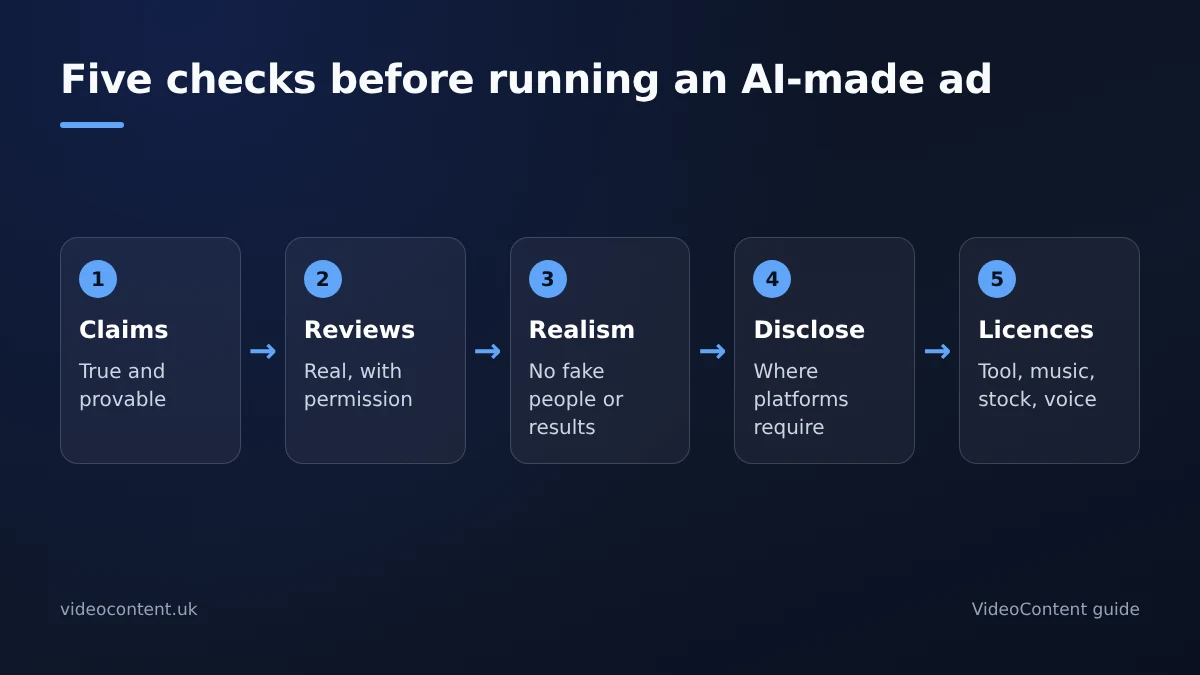
- Is every claim true, and can you back it up?
- Are all reviews, testimonials and results real, with permission?
- Does it show any AI people or scenes that could be taken as real? If so, label it or change it.
- Does the ad category or platform require an AI disclosure?
- Do you have commercial rights to the tool output, music, stock and voice?
FAQ
Is it legal to use AI-generated images or videos in ads?
Generally yes, if the ad is truthful, not misleading and you have the rights to everything in it. The usual advertising rules apply, whatever tool made the ad.
Do I have to label AI-generated ads?
Not always. Election and political ads on Google and Meta require disclosure of realistic synthetic content, and platforms ask for labels on realistic AI content in organic posts. Ordinary business ads often don't need a blanket label, but labelling realistic AI scenes is the safer choice.
Can I use AI to create customer testimonials for ads?
No. Fake testimonials are deceptive, and in the US the FTC's rule on fake reviews covers AI-generated ones. Use real reviews with the customer's permission.
Who owns an AI-generated ad?
Check your tool's terms first; VideoContent's terms say you own the videos you generate. Separately, in the US, purely AI-generated material may not be protected by copyright, while your own creative contributions can be.