AI Video Ads for Small Businesses: What Actually Works
Key takeaways
- AI is strongest at making many ad variations quickly, so you can test hooks instead of guessing.
- Test an ad as an organic post first; only pay to boost the version that already holds viewers.
- Use vertical 9:16, captions on, and a hook in the first two seconds on Reels, TikTok and Shorts.
- Never use AI to fake testimonials, results or people; regulators treat fake reviews seriously.
- Film the real thing when the ad depends on trust in your premises, your team or a visible result.
AI video tools have made it cheap to produce an ad. That's useful, but it also means everyone's feed is full of them. The small businesses getting results aren't the ones with the slickest AI ad; they're the ones using AI to test more ideas, then putting money behind the one that already works. Here's what that looks like in practice.
What can AI do well in video ads?
Think of AI as a fast assistant, not a creative director. It's good at the parts of ad-making that are slow and repetitive, and weak at the parts that need judgment.
| Job | AI handles it well? | Notes |
|---|---|---|
| Writing hook variations | Yes | Ask for ten, keep two |
| Captions and resizing | Yes | Check names and prices |
| Voiceover | Mostly | Listen for mispronounced local names |
| Visuals for a concept or offer | Often | Can look generic without your details |
| Showing real results or people | No | Film it, or don't show it |
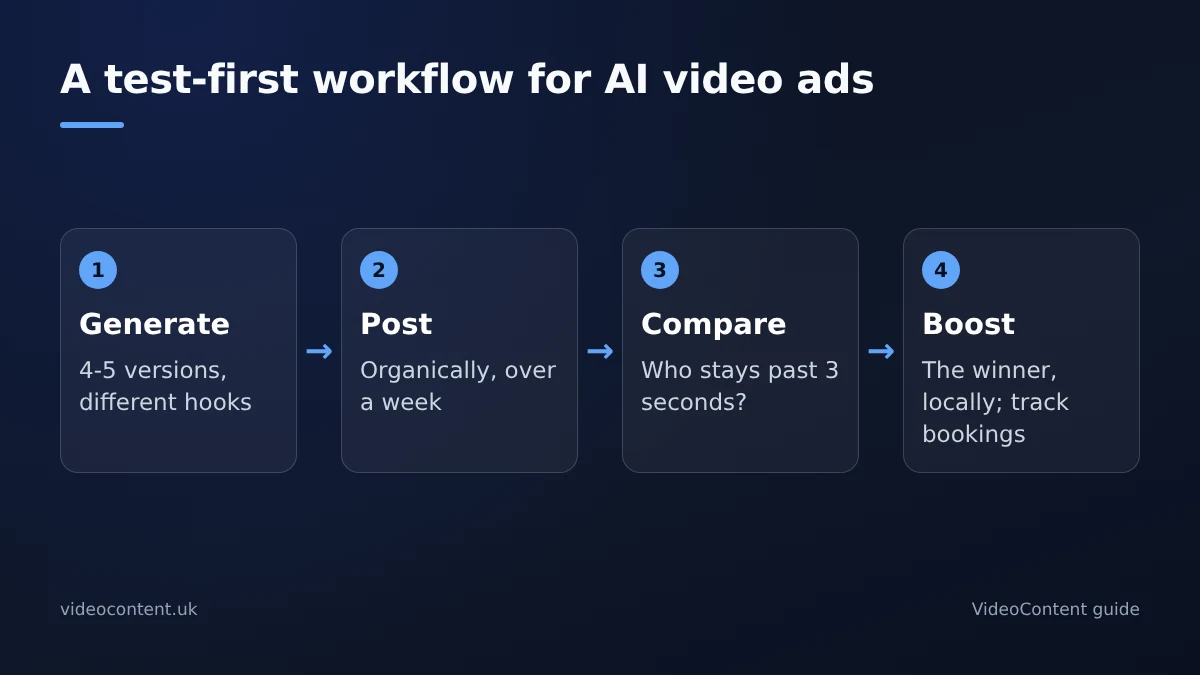
The biggest gain isn't one great ad. It's being able to try five openings for the price of one, and letting viewers tell you which works.
A test-first workflow for small budgets
- Pick one offer and one audience, such as a first-visit discount for people within a few miles.
- Generate four or five versions that differ only in the first line: a question, a number, a before-and-after, a myth.
- Post them as normal organic videos over a week or two.
- Compare how many viewers stay past the first few seconds and how many tap through.
- Boost the winner to a tight local radius with a small daily budget, and track bookings, not views.
This keeps your ad spend on proven creative. It also gives you a library of hooks to reuse next month.
Where VideoContent fits
VideoContent writes the script, captions and voiceover and renders a vertical video from your business details; a Standard video is finished within 60 seconds. That makes the variation step quick. Pro at $19 a month includes unlimited Standard videos. It doesn't run or target paid ads, so you'd boost the winner in Meta, TikTok or Google's own ad tools.
Format basics for each platform
- Vertical 9:16 for Reels, TikTok and Shorts placements.
- Captions burned in, because many people watch with the sound off.
- The hook in the first two seconds; don't open on a logo.
- Keep text away from the top and bottom edges, where buttons and captions sit.
- One message per ad. If you have two offers, make two ads.
Check each platform's ad specs before you launch, as lengths and safe zones change. Meta's and TikTok's ad help centres list current requirements.
What not to do with AI in ads
Some uses of AI aren't just bad marketing; they can get you in trouble. Don't create fake customer testimonials or reviews: in the US, the FTC's rule banning fake reviews and testimonials explicitly covers AI-generated ones. Don't show results you can't deliver, and don't present AI-generated people as real staff or customers.
Platforms also ask for disclosure of realistic synthetic content in many cases; see TikTok's guidance on AI-generated content. When in doubt, label it.
When should you film instead?
Film the real thing when the ad's job is trust: your treatment room, your team, a finished kitchen, a dish coming out of the oven. Those are exactly the things a viewer wants proof of, and a generated version undercuts the point. AI earns its place for offers, explainers, tips and seasonal promotions, where the message matters more than the footage.
FAQ
Do AI-generated video ads perform as well as filmed ones?
It depends on the job. For offers, tips and explainers, a well-made AI video can work fine, especially if you test several hooks. For anything that depends on trust in real people, premises or results, filmed footage usually wins.
How much should a small business spend testing AI video ads?
Start with organic posts, which are free, to find the hook that holds viewers. Then boost only the winner with a small daily budget to a tight local radius, and judge it on bookings rather than views.
Is it legal to use AI-generated people in ads?
Using AI visuals isn't illegal in itself, but presenting AI people as real customers or staff, or creating fake testimonials, can break advertising and consumer-protection rules. The FTC's rule on fake reviews covers AI-generated testimonials.
Can VideoContent run my ads?
No. VideoContent makes the vertical videos and can schedule organic posts on Pro+. Paid boosting and targeting happen in each platform's own ad tools.