Common Mistakes Small Businesses Make With AI Marketing Content
Key takeaways
- The most expensive AI mistake is publishing a wrong price, date or claim. Check every fact before posting.
- Generic prompts produce generic content; give the tool your real details.
- Posting more isn't better if nobody reviews it. Platforms penalize mass-produced, repetitive content.
- Never use AI to fake reviews, testimonials or results.
- Measure bookings and enquiries, not how many posts the tool produced.
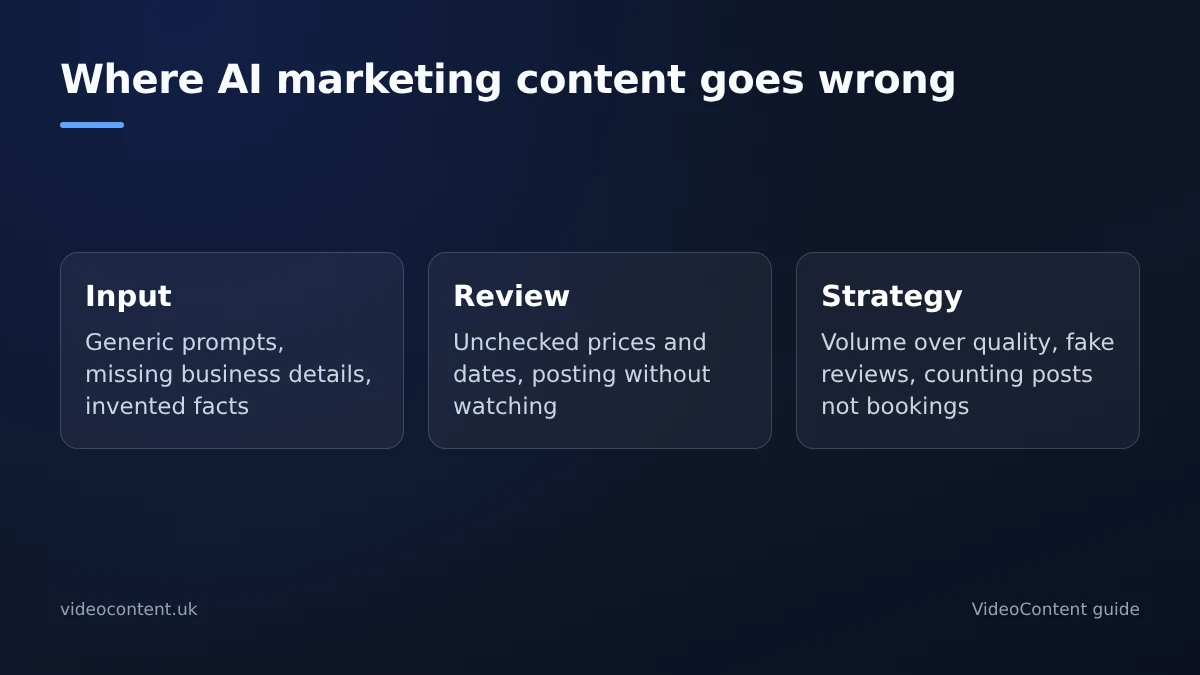
AI tools are good enough now that the mistakes have moved. It's rarely the grammar. It's a wrong opening time posted to 2,000 followers, a month of videos that all sound the same, or a fake testimonial someone thought was harmless. These are the eight we see most often with small businesses, and what to do instead.
Mistakes with what goes in
1. Generic prompts
"Write a post about our gym" gets you a post about any gym. Give the tool your class times, your prices, your neighbourhood and a real question a member asked. The more specific the input, the less editing the output needs.
2. No business details saved
If you retype your details every time, you'll eventually forget one, and the tool will fill the gap with a guess. Save them once. In VideoContent, your business details feed every script.
3. Asking AI for facts it can't know
AI tools can invent statistics, laws and "studies show" claims that sound convincing. If a post needs a number, get it from a source you can link to, or leave it out.
Mistakes with review
4. Not checking prices, dates and names
This is the one that costs real money: a promotion that ended last week, a wrong address, a misspelled street, a treatment you don't offer. Read every script before it renders and watch every video before it posts. It takes a minute.
5. Posting without watching
AI voiceovers mispronounce local place names and brand names. Captions mishear words. You'll only catch these by watching the video, ideally on your phone, where text near the edges can be hidden by buttons.
Mistakes with strategy
6. Chasing volume over quality
Being able to make 30 videos a day doesn't mean you should post them. YouTube's monetization policies single out mass-produced, repetitive content, and other platforms' feeds tend to reward videos people actually watch, not the number you upload. One good video a day beats five forgettable ones.
7. Faking reviews, testimonials or results
It's tempting to generate a glowing customer quote or a perfect before-and-after. Don't. Besides destroying trust when someone notices, it can be illegal: the US FTC's final rule on fake reviews covers AI-generated testimonials. Use real reviews, with permission.
8. Measuring output instead of results
"We posted 60 videos this month" isn't a result. Track calls, enquiries and bookings for each channel, and compare. If AI content isn't moving those numbers after a few weeks, change the content, not just the volume.
A five-minute checklist before you post
- Is every price, date, name and address correct?
- Does the first line sound like you?
- Is there at least one detail only your business could say?
- Have you watched it once on a phone, sound on and sound off?
- Is anything shown as real that isn't?
If you can answer yes, yes, yes, yes and no, post it.
FAQ
What is the biggest mistake businesses make with AI content?
Publishing without checking. A wrong price, date or claim does more damage than awkward wording. Read every script and watch every video before it goes out.
Will posting lots of AI content hurt my reach?
It can if the content is repetitive and nobody watches it. YouTube's monetization policies target mass-produced content, and feeds generally reward videos people watch. Post fewer, better videos.
Can I use AI to write customer testimonials?
No. Fake testimonials mislead customers, and in the US the FTC's rule on fake reviews covers AI-generated ones. Use real reviews with the customer's permission.
How do I make AI content less generic?
Give the tool real details: prices, places, opening hours and real customer questions. Then rewrite the first and last lines yourself.