How to Make AI Social Media Content Feel Authentic
Key takeaways
- AI content feels robotic when it could be about any business. Specific details are the fastest fix.
- Feed the tool real material: your prices, your street, the question a customer asked yesterday.
- Rewrite the first line and the last line yourself. That's where people decide whether a person is behind the post.
- Mix AI videos with real footage of your team and premises, even shaky phone clips.
- Label realistic AI content where platforms ask you to; it costs nothing and protects trust.
Most people can spot an AI-written post within a sentence or two. It's not that the grammar is wrong; it's that nothing in it could only have come from you. The good news is that the fix isn't to stop using AI. It's to give it what only you have, and to keep your hands on the parts people actually notice. Here's how we'd do it for a small business posting short videos every week.
Why does AI content feel robotic?
Read three AI-written captions from three different salons and you'll notice they're interchangeable. "Elevate your look." "Self-care isn't selfish." "Book your glow-up today." Each line is fine. Together they say nothing, because the tool was never told anything specific.
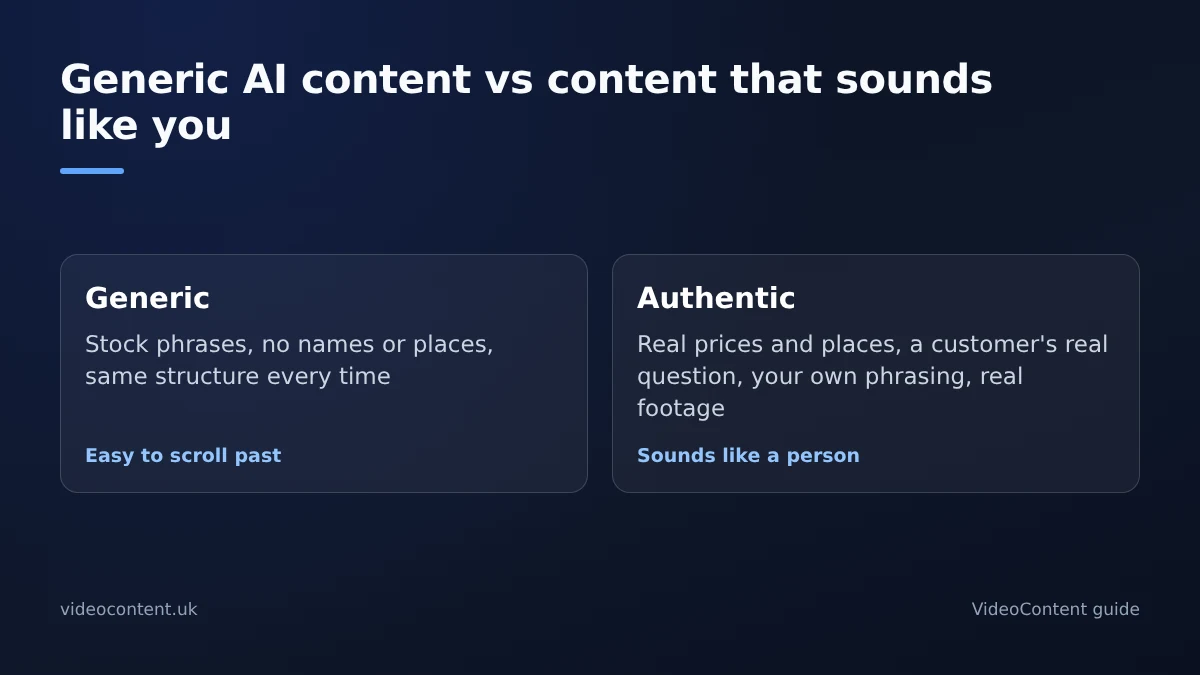
Three things give it away: stock phrases that could apply to anyone, no names, places or numbers, and the same structure every time (hook, three benefits, call to action). Viewers have seen thousands of these. They scroll past without deciding to.
Seven ways to make AI content sound like you
1. Start from a real moment
Instead of "write a post about teeth whitening," try "a customer asked me today whether whitening hurts. It doesn't, but sensitive teeth can tingle for a day." The second prompt gives the tool a question, an answer and a tone. The output will sound like a person because it started with one.
2. Give it the details only you know
Prices, street names, opening hours, the name of your best-selling dish, how long the wait really is on Saturdays. Specifics are what make a post feel local. In VideoContent, these go into your business details once, so every script can use them.
3. Rewrite the first and last lines yourself
The opening line decides whether anyone keeps watching, and the closing line is where they decide whether to act. These are the two places worth your own words. Leave the middle to the tool if you like.
4. Keep a short list of words you'd never say
If you'd never say "elevate", "unlock" or "game-changer" out loud, ban them. Paste the list into your prompt or delete them when you review. It's a two-minute habit that removes most of the giveaway phrasing.
5. Mix in real footage
AI videos are useful for the days you have nothing to film. But a shaky 10-second clip of your team setting up, or a finished job, does something a generated video can't: it proves you exist. A good rhythm for many local businesses is a couple of real clips a week, with AI videos filling the gaps.
6. Reply like a human
Comments are where authenticity is won or lost. Answer them yourself, in your own words, and quickly. A post with a generated script and a real, warm reply underneath feels more personal than a hand-written post nobody responds to.
7. Change the format now and then
If every video has the same structure, people stop noticing. Rotate between a question you answer, a myth you correct, a behind-the-scenes moment and a straight offer.
Should you tell people you use AI?
You don't need a disclaimer on every caption. But platforms do ask you to label realistic AI content: YouTube asks creators to disclose realistic altered or synthetic content, and TikTok asks you to label AI-generated content that shows realistic scenes. Meta adds an "AI info" label when it detects AI-generated media.
The rule we'd follow: never use AI to show something that didn't happen. No made-up customer testimonials, no fake before-and-afters, no AI "staff" presented as real people. That's where trust breaks, and in some places it's a legal problem too.
A simple weekly routine
- Monday: jot down three real things from last week, such as a customer question, a job you were proud of and something that changed.
- Generate scripts from those notes, not from a blank topic.
- Rewrite each hook and closing line in your own words.
- Film one or two real clips during the week.
- Schedule everything, then spend the time you saved answering comments.
FAQ
Can people tell when social media content is written by AI?
Often, yes, when it's generic. Stock phrases, no specific details and identical structure give it away. Content built from real details, with the hook rewritten by a person, is much harder to spot and, more importantly, more useful to the viewer.
Do I have to disclose AI-generated content on social media?
For realistic AI content, platforms like YouTube and TikTok ask you to label it, and Meta may add its own label. You don't need to label every AI-assisted caption, but never present AI scenes, people or testimonials as real.
How much editing should AI content get before posting?
At minimum, rewrite the first line and the last line, check every fact and price, and remove phrases you'd never say. For most short posts that's a few minutes.
Is it better to use AI or real footage for local business videos?
Both. Real footage proves you exist and builds trust; AI videos keep you posting on days you have nothing to film. Many local businesses mix a couple of real clips a week with AI videos.