Can You Make Money With a Faceless YouTube Channel in 2026?
Key takeaways
- Faceless channels join the YouTube Partner Program on the same terms as any other channel: 1,000 subscribers plus 4,000 long-form watch hours in 12 months or 10 million Shorts views in 90 days.
- An earlier tier at 500 subscribers unlocks fan funding such as channel memberships and Super Thanks, but no ad revenue.
- With no host on screen, the review rests on your script, narration and editing. Videos that look like one template repeated are what fail.
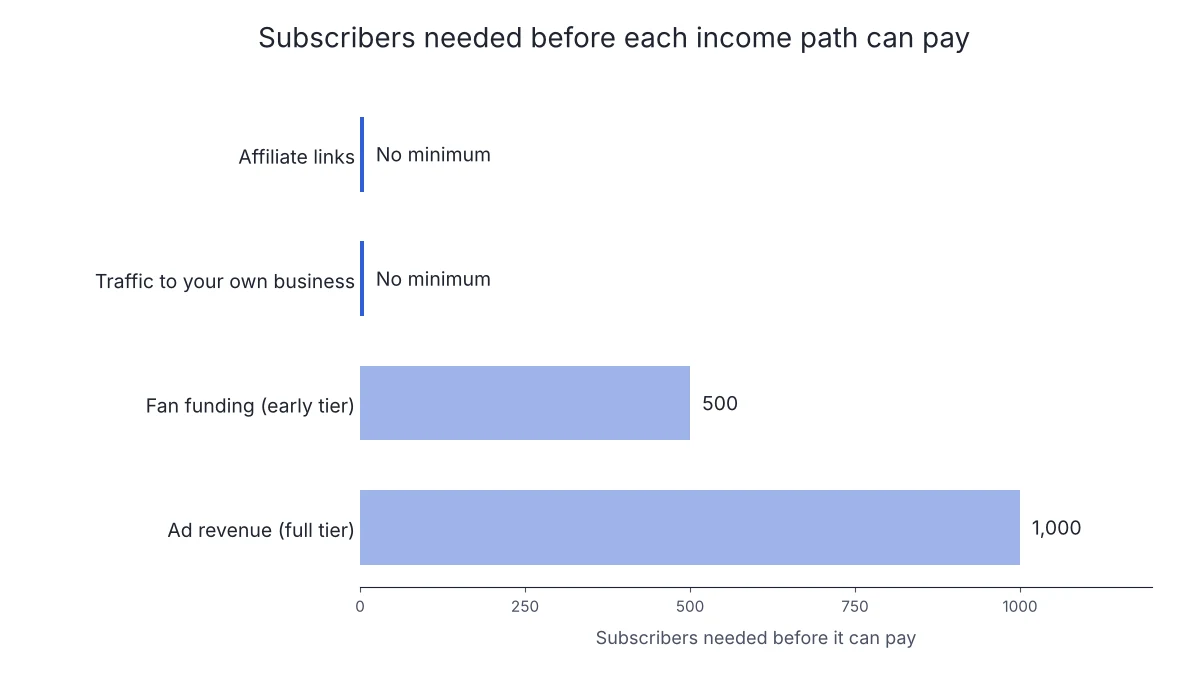
- Affiliate links and traffic to your own business can pay before you reach either tier. Ad revenue comes last.
- On VideoContent, an AI-assisted channel costs $19 to $79 a month, depending on whether you post the videos yourself or have them posted for you.
Yes, a faceless YouTube channel can make money in 2026. Ad revenue starts only after you join the YouTube Partner Program, which needs 1,000 subscribers plus either 4,000 long-form watch hours in 12 months or 10 million Shorts views in 90 days (YouTube Help). This guide covers those thresholds, the income that pays sooner than ads, and what an AI-assisted channel costs to run.
What is a faceless YouTube channel?
A faceless YouTube channel publishes videos with narration, stock footage or AI visuals instead of an on-camera host. You never appear on screen. The voiceover, captions and visuals carry the video, so anyone who can write a script can publish without filming.
Formats that work without a face
The formats that hold up are story videos, countdown shorts, news shorts, true crime breakdowns and top-5 lists. Each one pairs a scripted voiceover with visuals that illustrate the point. If you run a local business, the same structure works for promo videos: a restaurant can narrate a countdown of its five best sellers over footage of the dishes. Tools built for this write the script, narrate it and render the vertical video for you. We compare them in our faceless channel tools comparison.
Why faceless suits Shorts
Shorts can run up to three minutes, but most are under 60 seconds, and viewers decide in the first couple of seconds whether to keep watching. A face adds little to a countdown or a top-5 list. A sharp hook, captions and quick cuts do the work. Taking yourself out of the frame also removes the slowest part of production: there is no filming, no lighting and no retakes. That is what makes posting every day realistic for one person.
Can a faceless channel join the YouTube Partner Program?
Yes. YouTube has no rule against faceless channels, and the eligibility thresholds are the same for everyone. What decides the outcome is the channel review. With no person on camera, the reviewer has only your script, narration and editing to judge whether the channel is original work.
The reused content rule
YouTube's channel monetization policies define reused content as channels that repurpose material already on YouTube or elsewhere online without adding enough of their own. The rule applies even when the original creator gave you permission. Narration you wrote, your own edit and commentary that changes what the viewer takes away are what count as added value.
The inauthentic content rule
In July 2025 YouTube renamed its "repetitious content" policy to "inauthentic content". It covers videos that are mass-produced, generic or repetitive, including content that looks like it was made with a template. This is the rule most likely to catch an AI-assisted channel, because it is easy to publish fifty videos that differ only in the stock clips.
What reviewers look at
Reviewers cannot watch everything, so YouTube says they focus on a few things:
- The channel's main theme
- Your most viewed videos
- Your newest videos
- The videos with the biggest share of watch time
- Titles, thumbnails and descriptions
- The channel's About section
What passes: scripted narration over your own choice of visuals, a consistent voice and format, and videos that are clearly different from each other. What fails: the same template with swapped stock clips, unedited machine-written scripts, and ten uploads that look identical. Any tool you use, including our YouTube Shorts generator, should be a production aid. It is not a substitute for a point of view.
What are the subscriber and watch-hour requirements?
YouTube has two tiers in most countries. The full tier, which includes ad revenue, needs 1,000 subscribers plus either 4,000 public long-form watch hours in the last 12 months or 10 million public Shorts views in the last 90 days (YouTube Help). The earlier tier opens fan funding at 500 subscribers. YouTube's creator site explains each earning feature.
| Requirement | Early tier (fan funding) | Full tier (ads and fan funding) |
|---|---|---|
| Subscribers | 500 | 1,000 |
| Public uploads | 3 in the last 90 days | No minimum |
| Watch hours | 3,000 in 12 months | 4,000 in 12 months |
| Or Shorts views | 3 million in 90 days | 10 million in 90 days |
| What you get | Channel memberships, Super Thanks and other fan funding | A share of ad revenue, plus fan funding |
Shorts views never count toward the watch-hour route, so a Shorts-only channel qualifies through views. Our YouTube Shorts monetization checklist covers each threshold and the application steps. A channel built around one niche is also easier for viewers and reviewers to understand than scattered uploads. For an example of a single-niche format, see the real estate AI video demo.
How do faceless channels make money beyond ads?
Ad revenue is the slowest path. Others can pay sooner, and two of them work before you reach any threshold.
Affiliate links, sponsorships and products
Affiliate links in your descriptions pay per sale or signup, so they can earn at any subscriber count. Disclose them. Sponsorships depend on a defined audience and steady posting more than on size, so a channel with a clear niche can be worth a sponsor's money earlier than a general one. Digital products such as a course, a template pack or a checklist sell best when your videos keep solving one specific problem. Channel memberships need at least the early tier, so treat them as a later addition.
Using a faceless channel to feed a local business
This is the fastest return for owner-operators, because the product already exists. A faceless channel that posts short videos about your services sends viewers to your booking page, and one booked appointment can be worth more than a month of Shorts ad revenue. You are not waiting on a threshold. You are waiting on the phone to ring.
A realistic order: affiliate links first, traffic to your own business second, then sponsorships and products once the channel has shown it can post every day.
Which faceless niches earn most reliably?
Niches that tend to pay better
Finance explainers usually sit at the top, because advertisers pay more to reach audiences making money decisions. A faceless channel on budgeting, credit or small-business tax tends to earn more per thousand views than entertainment niches. True crime and history stories hold viewers to the end and stay watchable for months, so one video can keep earning. Countdown and ranking shorts are the quickest to produce, which matters when the goal is daily posting.
We scored ten ideas on effort, ad rates and how well they automate in 10 faceless channel ideas, scored and ranked.
Niches that struggle
Generic motivation quotes and slideshow compilations are the formats most exposed to the inauthentic content rule, and advertisers pay little for them. Local-business promo channels sit in between. They rarely earn meaningful ad revenue, but they pay for themselves by bringing customers to your gym, restaurant or brokerage.
How do you set one up with AI tools?
- Pick one niche you already know, such as med spa treatments, restaurant prep or local real estate.
- Create the channel with a clear name and a one-line description. Reviewers read the About section when you apply.
- Write the script first. A 60-second short is about 130 to 150 words. Draft with AI if you like, then edit so it sounds like you.
- Render the video with captions. Captions matter because many viewers watch with the sound off.
- Schedule a week at a time, then check your analytics weekly to see which topics hold viewers and script more of those.
Match the tool to the job, because "AI video generator" covers several different products. If you need vertical videos made from scratch, VideoContent writes the script and renders the video, and a Standard video is finished within 60 seconds. Story Reels goes further and runs a faceless story series for you: it finds real stories, checks them against sources, narrates each one and posts on your schedule. If you are cutting long recordings into shorts, OpusClip fits that job better. AutoFaceless and ShortGenius are built around faceless channel workflows, and Submagic is a captions and editing tool.
The trade-off with VideoContent is that it makes short-form video only. If your plan is long-form uploads, use it alongside a video editor. For the full walk-through, see how to create a faceless AI YouTube channel.
What does it cost, and what can it earn?
Monthly cost
Editing by hand costs nothing in cash but takes hours per video. With AI doing the writing, narration and rendering, the cost moves to a subscription. On VideoContent the options are:
- Free: 3 script generations and 1 watermarked video, to test your format.
- Pro at $19 a month: finished videos that you post yourself.
- Pro+ at $39 a month: adds scheduled posting to one platform. Posting to two, three or all four platforms is $59, $69 or $79 a month.
- Story Reels at $40 a month: one faceless series that makes and posts its own episodes.
Current prices are on the pricing page.
What to expect in the first year
There is no ad revenue until you are in the Partner Program, and there is no fixed timeline for getting there. Once you are in, Shorts are paid from a pooled ad fund of which creators receive 45%, shared by views, and that usually works out to cents per thousand views. Treat early ad revenue as pocket change. A subscription of $19 to $40 a month is covered far sooner by one affiliate sale or one booked customer than by ad payouts, which is why the order of income paths above matters.
What gets faceless channels rejected from monetization?
The usual causes are these, and each has a fix:
- Unedited AI scripts read by a stock voice. Fix: write or rewrite the script yourself, with a clear point of view.
- Duplicated content. Fix: retell news or other people's stories in your own words, with your own commentary.
- Misleading titles and thumbnails. Fix: make them match what the video delivers.
- Mass-produced, repetitive videos. Fix: vary the hook, the structure and the visuals, so ten videos do not look like one video ten times.
- Bought subscribers. Fix: never buy them. YouTube removes fake accounts and can act against the channel.
Tools that post for you, ours included, only help if each script is distinct. Volume without originality is the quickest route to a rejection.
FAQ
Do faceless YouTube channels get demonetized more often than regular channels?
YouTube does not publish figures by channel type, and the rules are the same for everyone. In practice the review is harder to pass, because with no host on camera the reviewer has only your script, narration and editing to judge. Narration you wrote, a distinct visual style and varied uploads pass. Identical template videos with swapped stock clips fail.
How long does it take a faceless channel to reach 1,000 subscribers?
There is no fixed timeline. Posting daily in one niche with a consistent format gives you the most chances to be found, and Shorts views count directly toward the Shorts route. Plan for the first months to bring little or no ad revenue while you work toward the thresholds.
Can I run a faceless YouTube channel completely free?
Yes, if you edit by hand with free tools and stock footage. The cost is time: several hours per video adds up quickly at a daily pace. Paid AI tools trade that time for a subscription. On VideoContent, finished videos start at $19 a month, and the free plan includes 3 script generations and 1 watermarked video.
Does YouTube allow AI-generated voices on monetized channels?
Yes. YouTube has no rule against AI voices. What it judges is whether the channel is original and not mass-produced, so an AI voice reading a script you wrote is fine, while raw text-to-speech over stock clips risks the inauthentic content rule. Separately, realistic altered or synthetic content must be labeled when you upload (YouTube Help).
Is a faceless Shorts channel or a long-form channel better for ad revenue?
Long-form usually earns more per view, because Shorts are paid from a shared pool. Shorts are quicker to make and can reach the 10 million views route without any watch hours. Many creators use Shorts to grow the channel and add long-form once there is an audience.