How to Launch a Faceless News Channel, Step by Step
Key takeaways
- A faceless news channel pairs a script and narration with public-domain, Creative Commons or licensed footage, so you never appear on camera.
- Pick a niche advertisers are comfortable with, such as weather or local news, and confirm every story in two independent sources before you script it.
- YouTube's reused content rule rejects other people's clips with captions added. Your own narration, graphics and analysis are what pass review.
- Batch explainers and countdowns once a week and schedule them. Make headline shorts on the day, because news goes stale.
- Affiliate links and local sponsors can pay before you reach YouTube's or TikTok's monetization thresholds.
You can run a faceless news channel that posts a short every day without appearing on camera. Pick a narrow news niche, use footage you are legally allowed to use, verify each story before you script it, then narrate, render and schedule. This guide walks through each step, including the copyright and reused-content checks that most guides skip.
What is a faceless news channel and how does it work?
A faceless news channel publishes short videos about a news niche without the creator appearing on camera. A script is written from verified sources, a narrator reads it, and stock or licensed footage fills the frame. You render a vertical short, add captions and hashtags, and post it to YouTube Shorts, TikTok and other platforms.
The three formats that work: headlines, explainers and countdowns
Headline shorts cover one current story in 30 to 45 seconds. Explainers give context on a story people keep seeing but do not understand. Countdown shorts rank things: the five biggest stories of the week, or the three developments to watch. Rotating all three keeps daily posting sustainable, because only the headline short has to be made the same day.
Why news suits a faceless format
News starts as text, so scripts come from sources you can check instead of footage you have to film. The audience comes for the story, not a personality. Earning from it still depends on platform rules: the YouTube Partner Program needs 1,000 subscribers plus either 4,000 long-form watch hours in 12 months or 10 million Shorts views in 90 days (YouTube Help).
If you are weighing tools for this, see our faceless channel tools comparison.
Which news niches work best for a faceless channel?
Score any niche on four things: how much demand there is, how much of it stays watchable after the day it happens, whether advertisers are comfortable next to it, and how crowded it already is. The table is our own rough assessment, not measured data. Use it as a starting point and check your niche yourself.
| Niche | Demand | Evergreen share | Ad-friendliness | Competition |
|---|---|---|---|---|
| Finance news | High | Medium | Strong | High |
| Weather and severe alerts | High | Low | Strong | Low |
| Local news | Medium | Medium | Strong | Low |
| Sports scores | High | Low | Medium | High |
| True crime | High | High | Weak | High |
Niches advertisers avoid
True crime and hard news can pull views, but many advertisers stay away from them, and that matters once you apply for monetization. Finance, weather and local business news are easier to place ads against. If you want true crime's audience, keep the framing measured: case timelines and court outcomes, not graphic detail. A faceless channel automation workflow should be producing the safer explainer angles.
Matching the niche to what you can sustain
A news channel is expected to post daily, so choose a niche you can keep up. Weather and sports bring new material every day and need little research beyond the official source. Local news suits an owner-operator who already follows their town. Finance and true crime take more sourcing time per video, so budget for it before you commit.
How do you source and verify news content legally?
Footage you can and cannot reuse
Safe sources include public-domain archives such as NASA and other government footage, press-release footage from the organizations you cover, and Creative Commons videos on YouTube. You can find those with the Creative Commons filter in YouTube search, and you must credit the original author when you reuse them (YouTube Help). Paid stock libraries work too, as long as the licence covers commercial use in video.
What you cannot do is download another channel's clip or a broadcaster's segment and upload it again. YouTube's reused content policy targets channels that repurpose material without adding enough of their own, and it applies even when the original creator gave permission. Your own narration, captions and analysis over footage you are allowed to use is the safe pattern.
Verification: two sources before you script
Before you write anything, confirm the story in two independent outlets. Two sites carrying the same wire report count as one. Note the original source, the date and any named official, and put the attribution in your script.
Accurate, attributed reporting also lowers your risk if someone disputes a video. It is not legal advice, and it does not make a claim true, but "the city council said on Tuesday" is a very different sentence from a rumour stated as fact. Script from your notes, then narrate and render. Once the day's video is done, schedule it with a TikTok video scheduler so it goes out on time while you check tomorrow's story.
What is the fastest workflow for daily news shorts?
The daily pipeline, step by step
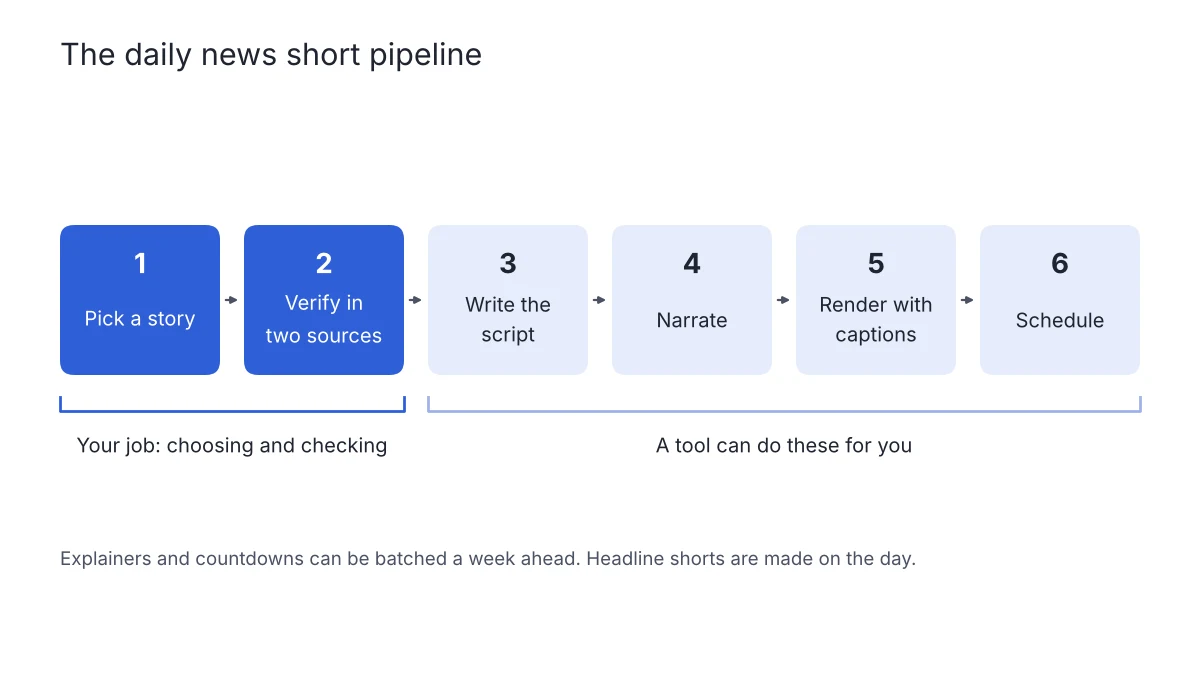
The repeatable pipeline is: pick one story, verify it, write the script, narrate it, render a vertical video with captions, then schedule it. Done by hand across separate tools, that is a long session for every short.
VideoContent covers this in two ways, depending on your niche.
For world news, Story Reels has a World News and Geopolitics niche that runs the whole pipeline. Each episode is built from credible sources published in the last 24 hours, the script attributes claims and keeps confirmed facts apart from them, and the episode is narrated and posted on the days you choose to YouTube Shorts, TikTok, Instagram and Facebook.
For any other niche, such as local news or weather, you write a short verified summary yourself and turn it into a narrated video with Blog to Video, which accepts your text or a link to your own article.
Where it falls short: the sourced pipeline covers world news only, not your town or your sport. On the second route the tool does not check your facts. That step stays with you, and it should. Either way the channel is yours, so watch what goes out under your name.
Batching a week of shorts in one sitting
Producing every day from scratch wears people out, so batch what you can. Explainers and countdowns do not expire overnight. Write and render a week of them in one sitting and schedule one per day. Keep headline shorts for the day itself, because a story verified on Sunday may have changed by Thursday. That turns a daily chore into one weekly session plus a short daily check.
What platform policies and copyright rules apply?
Both platforms judge the same thing: whether the video is your work. Clips taken from broadcasts or other creators with only captions or a voiceover added are what get channels rejected. You pass by adding something the raw footage does not have: your own reporting, on-screen analysis, and context that changes what the viewer understands.
Fair use is narrower than many beginners assume. US law lists news reporting and commentary as examples of uses that may qualify, but courts weigh four factors case by case, including whether your use adds new meaning and whether it harms the market for the original. There is no fixed number of seconds that is automatically safe (U.S. Copyright Office). Replaying someone's footage with nothing added is the weakest position to be in. This is general information, not legal advice.
Music is a separate trap. A trending sound that is fine in a personal post is not automatically licensed for a channel that earns money. Use tracks from a library whose licence covers commercial use.
YouTube: audit before you apply
Before applying to the Partner Program, look at your last 20 uploads. If any short is a news clip with captions pasted on, replace that workflow with one that scripts original narration, adds your own graphics and cuts footage to serve your script.
TikTok: originality
TikTok pays for original videos. A daily show with the same structure, narration style and visual treatment reads as your own format. A feed of collected clips does not. Rendering every short from a script you control helps here, because each video carries your treatment and not a source clip's.
The pre-publish checklist
Before each upload, confirm five things:
- You can name the source of every piece of footage.
- Your narration adds analysis the footage lacks.
- The music is licensed for commercial use.
- On-screen text credits the original reporting where relevant.
- The short makes sense to someone who has never seen the source material.
How do faceless news channels get monetized?
YouTube Partner Program
YouTube needs 1,000 subscribers plus either 4,000 public long-form watch hours in 12 months or 10 million Shorts views in 90 days (YouTube Help). A daily news channel builds Shorts views steadily, but reused footage without meaningful commentary is the common reason for rejection. Narrate your own script over footage you are allowed to use, add original graphics, and keep your commentary at the centre.
TikTok's Creator Rewards Program
TikTok's Creator Rewards Program needs at least 10,000 followers and 100,000 video views in the last 30 days, and it pays only for original videos longer than one minute (TikTok Support). A 40-second headline short does not qualify, so if TikTok income matters to you, plan a longer explainer format alongside the short ones.
Income before you are eligible
You can earn before either threshold. Put affiliate links for tools you really use in your descriptions, and disclose them. A local news channel can also sell a sponsored mention to a local business, since a gym or restaurant cares about reaching people in its own town more than about your total follower count.
How does a news channel compare with other faceless ideas?
News against story and true crime channels
News wins on supply and habit. There is a new story every day whether or not you feel creative, and viewers come back for the routine. The cost is verification work every day, plus closer scrutiny of reused footage. Story and true crime channels put the research into fewer videos that stay watchable for months. Countdown and list formats take the least effort per video but are the easiest to copy, and they are the most exposed to YouTube's rule against repetitive, template-like content. We scored these side by side in 10 faceless channel ideas, scored and ranked.
Judging tools on the same criteria
Judge any tool on four things: does it write a script from a real source, narrate it, render a vertical video with captions and hashtags, and post on a schedule. Submagic, OpusClip and quso.ai focus on repurposing footage you already have, which suits channels sitting on long recordings. AutoFaceless and ShortGenius are aimed at generated faceless content. VideoContent covers the whole chain, including scheduled posting, which matters most for a daily commitment.
On fact-checking we can only speak for our own product: Story Reels checks sources itself for its World News niche, and for nothing outside it. For any other niche, assume the sourcing is your job whichever tool you choose.
FAQ
Can I use news clips from other channels in my faceless videos?
No. Uploading another channel's clip or a broadcaster's segment again is what YouTube's reused content policy rejects, even with permission. Safer sources are public-domain archives, government footage, Creative Commons uploads with credit, press-release footage and licensed stock. Add your own narration and analysis over that material.
Do faceless news channels get monetized, or does YouTube reject them?
They can be monetized when each short adds something the raw footage lacks. Channels that are rejected are usually assembling clips with captions or a stock voiceover on top. Original scripting, your own graphics and commentary that changes what the viewer understands are what pass review.
How many shorts should I post per day on a faceless news channel?
One a day is a sensible bar, because a news channel runs on routine. Batch explainers and countdowns once a week and schedule them, and make headline shorts on the day so they are still accurate when they go out.
What is the cheapest setup for a faceless news channel with no editor?
A narrow niche, free public-domain and Creative Commons footage, free editing software and your own time. If you would rather pay than edit, pick one tool that writes, narrates, renders and schedules, so you are not paying for four. Whatever you choose, budget time for verifying each story.
Is a faceless news channel still worth starting in 2026?
Yes, if you pick a niche advertisers are comfortable with, such as weather or local news, and you can keep up daily verification. The posting routine is durable, and affiliate links and local sponsors can pay before platform monetization does. The cost is checking facts every day and taking care with footage you did not film.