Best Faceless Channel Ideas, Ranked by What Matters
Key takeaways
- The best faceless channel ideas for solo operators are niche how-to for your trade, local business tips and motivational quotes, based on weighted scores for effort, RPM and automation fit.
- Every idea is scored 1-5 on production effort (40%), RPM potential (30%) and AI-automation fit (30%), so daily posting beats high-RPM formats you cannot sustain.
- YouTube Shorts RPM is usually measured in cents per 1,000 views, with finance and business topics at the higher end, so volume and consistency matter more than niche RPM.
- High-effort formats like true crime rank last because research and scripting resist automation and lead to burnout.
- You can launch in a week: test your scripts on the free plan, post daily for 14 days, and only pay once the habit sticks.
Most faceless channel ideas fail for solo operators because they demand editing time you don't have or pay very little per thousand views. This article scores 10 ideas 1-5 on production effort, RPM potential and AI-automation fit, so you can pick one and launch this week. The top three for beginners are niche how-to for your trade, local business tips and motivational quotes.
Which faceless channel ideas are actually worth starting in 2026?
The best faceless channel ideas are the ones you can produce every day with little effort, not the ones with the biggest view counts. In our scored matrix of 10 ideas, the top three are niche how-to for your trade, local business tips and motivational quotes.
RPM still matters, because YouTube pays Shorts creators per thousand views and rates vary widely by niche. But Shorts RPM is small: Influencer Marketing Hub's Shorts RPM benchmarks put typical rates at a few cents per 1,000 views, with finance and business at the top. That is why the matrix weights effort heaviest. You can run any of the top ideas with faceless YouTube channel automation instead of editing daily.
How do you score a faceless channel idea before you start?
Every idea below gets a 1-5 score on three criteria, weighted so the total reflects what matters for a solo operator: production effort (40%), RPM potential (30%) and AI-automation fit (30%).
Production effort: minutes per finished Short
Score 5 means a finished vertical video in under 10 minutes with no editing. Score 1 means filming, cutting and captioning by hand. If an idea needs you on camera or in an editor every day, it loses points fast.
RPM potential: what a thousand views pays
Score 5 means a niche advertisers pay more for, such as finance or business. Score 1 means a niche at the bottom of the range, where even big view counts pay little.
AI-automation fit: can a tool do 90% of it?
Score 5 means script, voiceover, captions and vertical video can be generated end to end. We compare tools built for this in our faceless channel tools comparison.
The scored matrix: 10 faceless channel ideas ranked
Each idea is scored 1-5 on the three criteria: production effort (5 = least work), RPM potential and AI-automation fit (5 = an AI tool can run it end to end). The weighted total uses 40% effort, 30% RPM and 30% automation.
| Idea | Effort | RPM | Automation | Weighted total | Rank |
|---|---|---|---|---|---|
| Niche how-to for your trade | 5 | 4 | 5 | 4.7 | 1 |
| Local business tips | 5 | 3 | 5 | 4.4 | 2 |
| Motivational quotes | 5 | 2 | 5 | 4.1 | 3 |
| Top-5 product rundowns | 4 | 4 | 4 | 4.0 | 4 |
| History facts | 4 | 3 | 5 | 4.0 | 5 |
| Story reels | 4 | 3 | 4 | 3.7 | 6 |
| AI news shorts | 3 | 4 | 4 | 3.6 | 7 |
| Finance explainers | 3 | 5 | 3 | 3.6 | 8 |
| Relaxation and ambience | 3 | 2 | 4 | 3.0 | 9 |
| True crime shorts | 2 | 4 | 3 | 2.9 | 10 |
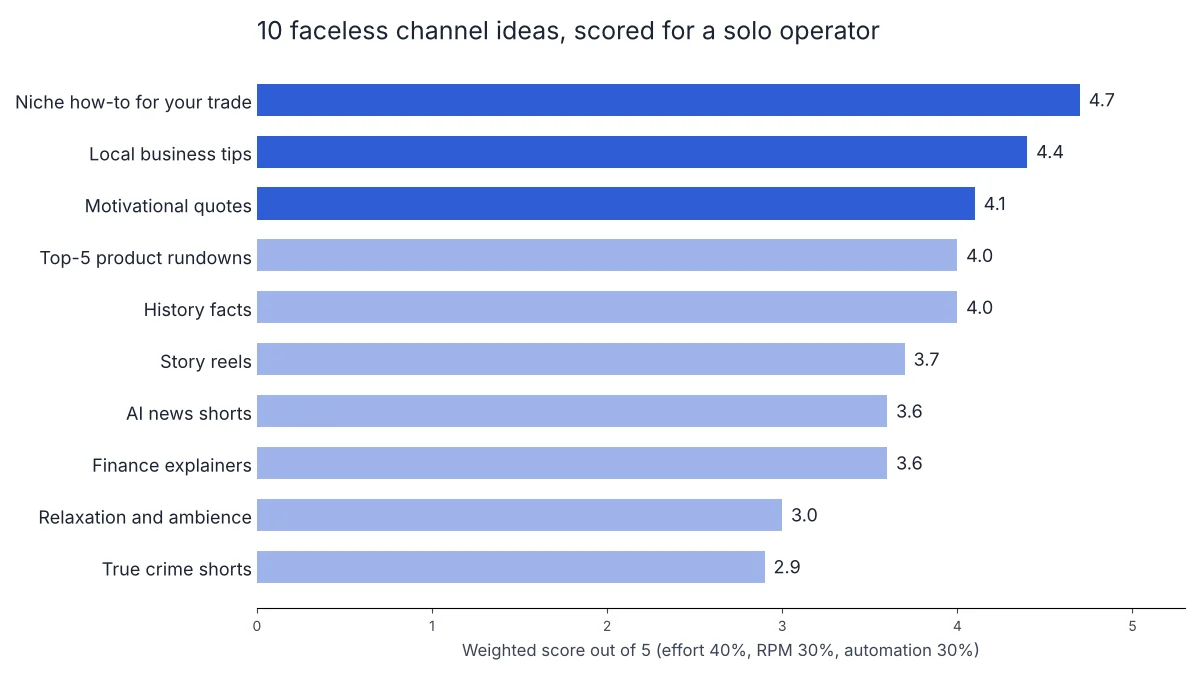
The pattern is blunt: the ideas you can automate daily beat the ideas with impressive RPMs that you will burn out producing. A trade how-to channel wins because your expertise is the script, and a generator turns it into captioned vertical video without editing. True crime ranks last despite strong watch time, because research and scripting resist automation.
Why do high-effort ideas lose for solo operators?
Documentary-style history and deep-dive finance score well on RPM, but they lose on the one thing that decides whether a channel survives: can you post daily without burning out?
A single polished history video can take two hours of editing. A solo operator with no editor cannot sustain that for 30 days straight, and daily posting is what compounds. The algorithm rewards consistency, not occasional masterpieces.
The fix is choosing ideas where production effort scores 4-5, so your daily upload takes minutes, not evenings. That is the case for AI-automated formats: the script, voiceover, captions and vertical video are generated for you, and you spend your time on hooks and hashtags instead of a timeline.
What are the 3 best faceless YouTube channel ideas for beginners?
1. Niche how-to for your trade
Format: 30-45 second tips from the work you already do, one problem per Short. Hooks name the mistake ("Stop sealing grout before it cures"), then show the fix. Post daily. Workflow: list 30 questions customers ask you, write one script per question, generate each with voiceover and captions, and schedule a week at a time. Your knowledge is the hard part, and you already have it.
2. Local business tips
Format: short, practical advice tied to a place or a service, such as what to check before hiring a roofer, or the best time to book a facial before a wedding. Hooks lead with the local angle. Post three to five times a week. These videos double as marketing: a gym owner can run the same loop on the business account, as shown in our AI video generator for gyms workflow.
3. Motivational quotes
Format: one quote or idea per Short, read over calm visuals with large captions. It is the least effort of any format, which is why it ranks third despite the lowest RPM. The risk is sameness: thousands of channels post the same lines. Stand out with a narrow angle, such as quotes for new founders or for night-shift workers, and a sentence of your own commentary after each quote.
Whichever you pick, keep each video original. YouTube's channel monetization policies require reused content to add meaningful commentary or transformation, and your script and narration are that transformation.
What about running a faceless channel for your actual business?
If you run a med spa, gym or salon, the matrix flips. Ad RPM stops mattering because one booked appointment is worth more than a month of ad revenue. Production effort and automation fit still count, but RPM is replaced by how fast videos bring in leads.
Score your business content the same way. Before-and-after transformations, FAQ answers and local tips all score high on automation fit because they follow repeatable formats. A restaurant showing daily specials or a realtor answering "what's my home worth?" needs volume and consistency, not cinema.
Run a business channel when you want the phone to ring. Run a separate monetized faceless channel only when you have spare hours and want a second income stream: it pays slower and competes with your actual job. For most owner-operators, one channel with a clear call to action beats two half-run ones.
Which AI tools can run these channels end to end?
Running the same criteria on the tools
Score the generators the way you scored the channel ideas. The category splits fast. OpusClip is built to clip existing long footage into Shorts, which is ideal if you already record podcasts or webinars. Submagic and SendShort focus on captioned, styled clips. CapCut is the free default most creators already have, but it assumes you will edit. quso.ai (formerly Vidyo) sits in the same clipping camp. None of these removes the scripting step for a faceless channel, and that step is where solo operators stall.
Where VideoContent fits and where it does not
VideoContent is built for the other path: scripted vertical videos from a prompt, with voiceover, captions and hooks generated for you, in under 60 seconds per video in Standard mode. Pro+ adds scheduled posting for the daily cadence the matrix rewards, and Story Reels runs a faceless story or list channel that writes, narrates and posts each episode for you. If your job is turning footage you already have into Reels, a clipper is the better pick. If your job is producing vertical video from nothing, five days a week, without opening an editor, this is the shorter road.
How do you launch one of these channels this week?
Day 1: pick one idea from the shortlist and commit to a single format, such as scripted tips with voiceover and captions. Day 2: use the free plan's 3 script generations and one video to check whether your hooks and captions are good enough to post as they are.
Days 3-16: post daily. One vertical video a day to TikTok, Reels and YouTube Shorts. Nothing else matters in this window.
Day 17: open your analytics and check how many viewers stay past the first 3 seconds. If they drop before second 3, rewrite your hooks, not your whole format.
Then decide. If posting stuck for 14 straight days, upgrade: videos start on Pro at $19 a month, and Pro+ at $39 a month adds scheduled posting. If you skipped days, fix the habit before paying for anything.
FAQ
How much does it cost to start a faceless YouTube channel?
Nothing to test. VideoContent's free plan includes 3 script generations and one watermarked video with no credit card. To post daily, videos start on Pro at $19 a month, and Pro+ at $39 a month adds scheduled posting. Your real cost is minutes per day, not dollars.
Can a faceless channel on YouTube actually get monetized?
Yes, provided your videos meet YouTube's monetization policies, which require reused content to add meaningful commentary or transformation. Your script and narration are that transformation. Pick a niche with decent RPM, post daily, and reach YouTube's subscriber and view thresholds before revenue starts.
What faceless AI channel ideas work with zero editing skills?
Scripted formats an AI tool can generate end to end: trade how-to tips, local business tips, motivational quotes, top-5 product rundowns, history facts and story reels. You paste a script or prompt, and the tool produces voiceover, captions and vertical video. If an idea requires filming or a timeline editor, skip it.
How many views do you need to make money from YouTube Shorts?
A lot. Shorts RPM is usually a few cents per 1,000 views, so 100,000 views typically earns somewhere around $5 to $15, a little more in finance and business niches. That is why the matrix weights production effort and automation fit over raw RPM, and why many owners use Shorts for leads rather than ad revenue.
Is it too late to start a faceless channel in 2026?
No, but the bar has moved. Generic clips and reused content get filtered out, while channels with a repeatable format, daily consistency and original scripting still grow. The advantage now goes to solo operators who automate production and spend their time on hooks and on keeping viewers past the first 3 seconds.