Podcast Shorts YouTube Channel Name Ideas and Patterns
The best podcast Shorts YouTube channel name ideas pair a niche signal with a clip-first promise, like "MedSpa Minutes" or "Gym Owner Cuts," because Shorts viewers decide in two seconds whether your clip is for them. This guide gives you seven name patterns with examples, a framework for matching the name to your niche and repurposing strategy, and a three-step availability check that generic listicles skip.
What makes a podcast Shorts channel name different from a regular podcast name?
A regular podcast name has one job: sound good spoken aloud in a podcast app. A Shorts channel name has a different job: get found in a vertical feed where viewers search for topics, not shows. Someone scrolling YouTube Shorts types "gym mistakes" or "med spa tips," not your podcast title, so a clips channel name built around searchable words beats a clever show name every time.
Handles also matter technically. YouTube lets you claim a handle that becomes your channel URL, and the rules around what counts as available are stricter than most people expect, per YouTube's own channel documentation. That's why we keep the availability checklist separate later.
Finally, a clips channel is a discovery funnel, not the brand itself. Viewers who like a 45-second clip should land somewhere that points back to full episodes. If you're running a faceless clips operation, the naming logic gets even more specific — see our guide to faceless YouTube channel automation.
Should your Shorts channel name match your podcast name or stand alone?
Match the podcast name when you're repurposing an existing show. Stand alone when you're building a faceless clips brand. Here's how to decide.
Match strategy: riding existing audience
If listeners already search for your podcast by name, reuse it. A fan who hears episode 42 and types your show's name into YouTube finds your Shorts channel instantly, and the two audiences feed each other. The tradeoff: your channel name is capped by your podcast's brand, so it can't outrank the show itself in search.
Stand-alone strategy: faceless clips channels
A faceless clips channel is its own product. Name it for the niche and the format, not the source show, because your growth comes from the YouTube Shorts feed, not from podcast loyalty. A name like "Salon Owner Daily" tells the algorithm and a cold viewer exactly what they'll get. Tools like VideoContent's YouTube Shorts generator make daily posting under a stand-alone brand realistic without editing.
Hybrid: podcast name plus a clips modifier
The middle path adds a modifier: "[Podcast Name] Clips" or "[Podcast Name] Shorts." You keep search overlap with the show while signaling that this channel is clips, not full episodes. It works best when your podcast name is short; a five-word show name plus "Clips" becomes unwieldy in a handle.
Seven patterns that work for clips
Repurposed clips live or die on search inside YouTube, where Shorts are recommended based on viewer history and video metadata (https://support.google.com/youtube/answer/10059070). A name built on a repeatable pattern tells a new viewer what the channel is before they press play, and it keeps every video title consistent.
Pattern 1-2: Clips and Cuts suffixes
Suffix names like "[Podcast] Clips" or "[Topic] Cuts" are the safest choice for a repurposing channel. They signal "this is pulled from something longer," which sets expectations and avoids confusion with the main podcast brand. A gym owner running a fitness podcast could use "Lift Heavy Clips"; a real estate agent, "Offer Accepted Cuts."
Pattern 3-4: Shorts and Minutes formats
Format names describe the runtime promise. "[Topic] in 60 Seconds" or "Two-Minute [Topic]" works when every clip honors the format. If a clip runs four minutes, the name starts lying, so only pick this if you can enforce the rule.
Pattern 5-7: Unfiltered, Daily, and personality-led names
| Pattern | Example (med spa) | Example (true crime) | Best when |
|---|---|---|---|
| Unfiltered | "Botox Unfiltered" | "Case Files Unfiltered" | Raw, opinionated clips |
| Niche+Daily | "Glow Daily" | "Daily Docket" | You post every day |
| Personality-led | "Dr. Kim Spills" | "The Autopsy Desk" | Host is the draw |
Personality-led names work best for faceless channels too, as long as the name describes the content rather than a person. A true crime clips channel built with a tool like the true crime shorts generator benefits from a niche-specific name because search intent is topic-driven, not host-driven.
Pick one pattern, test it against your directory collision check, and never blend two.
How do you match the name to your podcast niche?
Your niche sets the tone your name has to hit before anyone clicks. True crime rewards names that sound like a case file: short, specific, slightly ominous. Business podcasts reward authority, so a founder's name or a blunt promise works. Health and fitness rewards energy and repetition. Real estate and home services reward local trust markers, like a city or neighborhood in the name, because your Shorts are often the first thing a potential client sees.
The long paragraph worth quoting on its own: the mistake most owners make is picking a name that describes the podcast instead of the clip. A Shorts channel lives or dies on the scroll, so the name has to work in about two seconds on a phone screen, next to a 40-second vertical video, against nine other channels in the same feed. Ask one question: if someone saw only your channel name and nothing else, would they know in one breath what the clips are about and who they're for? "The Cutting Board" tells a restaurant audience nothing. "60-Second Service Secrets" tells a home-service audience everything. The same test applies whether you're repurposing a business podcast or running a faceless clips channel, and the naming choice should match the tool stack you pick for it (https://videocontent.uk/compare/faceless-channel-tools).
How do you check if a Shorts channel name is actually available?
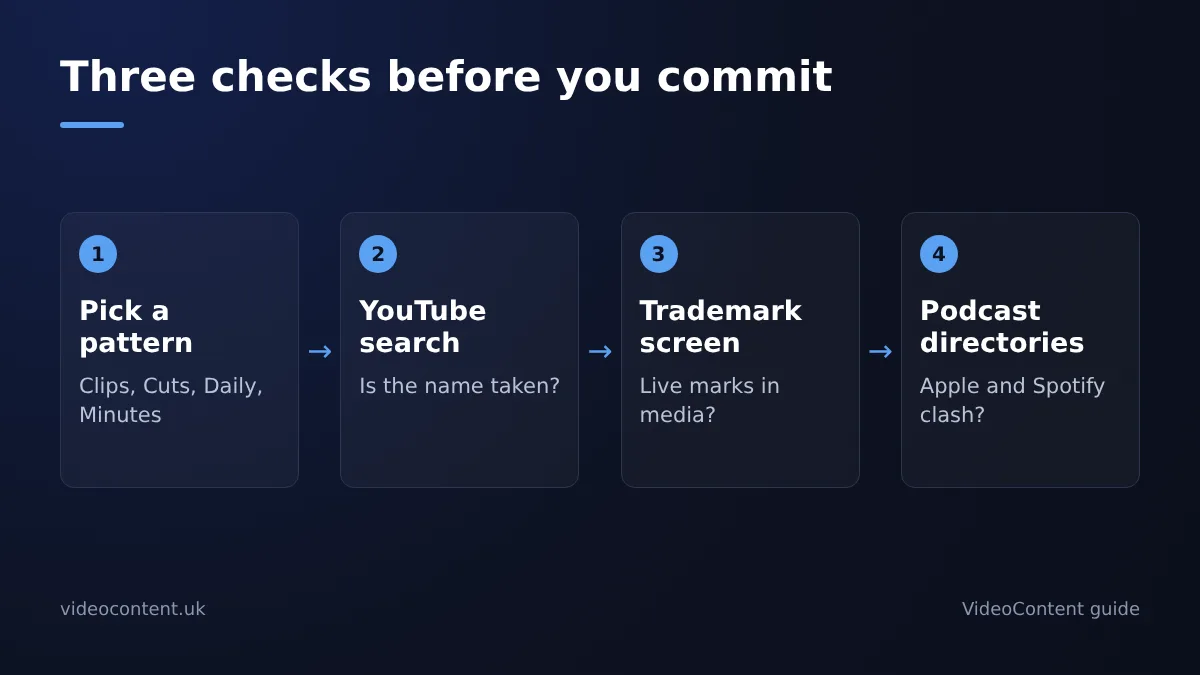
Run three checks before you commit. Each takes under ten minutes and saves you a rebrand later.
Step 1: YouTube handle and search results
Type the name into YouTube search, not just the handle claim screen. If three channels already use it, your clips will rank under theirs forever. Grab the exact handle, then check that a search for the plain name doesn't surface a bigger channel in your niche.
Step 2: Trademark quick screen
Search the name on the USPTO trademark search page and look for live marks in media or entertainment classes. A name with a live mark in your category is a cease-and-desist waiting to happen, even if the YouTube handle is free.
Step 3: Podcast directory collision
Search Apple Podcasts and Spotify for the same name. If a podcast owns it, your Shorts channel will fight that show for the same branded search, and listeners won't find either of you. If all three checks come back clean, lock the handle the same day. The same rule applies to a faceless clips channel built with VideoContent: name first, upload second.
Five mistakes that bury a channel
Five mistakes sink most Shorts channels before they post a single clip.
First, vague one-word names. "Clips" or "Moments" tells YouTube's search nothing, so you compete with millions of uploads for a term that describes every video ever made.
Second, numbers and underscores in handles. @fitness_clips_2024 looks like a spam account and gets mistyped, so word-of-mouth traffic dies at the keyboard.
Third, names that only work on TikTok. Slang-heavy handles like "povgymtok" confuse YouTube Shorts viewers and don't transfer to Reels, splitting your audience identity across platforms.
Fourth, trademark-bait names. Anything close to a major podcast or brand name invites a takedown claim, and YouTube acts on those fast.
Fifth, no niche signal. A name that could mean anything ranks for nothing. "MedSpaMinute" beats "DailyClips" because the keyword is in the handle itself.
How do you name a faceless podcast clips channel?
A faceless channel can't trade on a personality, so the name has to promise the format or the niche instead. "Daily Med Spa Clips," "Gym Owner Shorts," or "Restaurant Ops in 60 Seconds" tell a viewer what they get before they click, which matters because Shorts viewers decide in about two seconds whether to keep watching.
The strongest faceless names name a repeatable format: a hook style, a clip length, or a subject matter you can post every day without burning out. Test it by asking whether ten different videos could all sit under that name. If yes, you've got a format, not a mood.
Directory collisions matter less here than for audio podcasts, but check them anyway; podcast listings on Spotify for Creators show how names and show art are indexed, and a near-identical name in your niche will split your search traffic.
Once the name promises a daily format, you need a way to keep it. If you already record episodes, a clip repurposer like OpusClip or SendShort cuts them into vertical clips. If you would rather work from scripts, a script-to-video tool like VideoContent turns a written idea into a captioned vertical video. The name is the commitment; the tool is how you honor it without editing anything yourself.
When should you rebrand an existing Shorts channel name?
Rename when the name no longer matches what you upload. If you pivoted from gym content to med spa content and the old name says "FitClips," new viewers cannot tell what the channel is. A handle mismatch hurts too: if your handle is @MikeEats but the channel is now a faceless clips brand, you are building recognition for the wrong thing.
A sub-1,000-views plateau is a softer signal. Try new hooks and thumbnails for a month before blaming the name.
Migration is low-risk: YouTube lets you change the channel name without changing the handle, so subscribers stay. Update the handle only if the old one is confusing, and pin a comment explaining the change for a week.