Video Ideas for TikTok Without Showing Your Face
Key takeaways
- Six format families cover almost every faceless TikTok: before-and-afters, countdowns, hands-and-spaces behind-the-scenes, text-on-screen tips, data callouts and short story videos.
- Every faceless video is built from three blocks: footage, audio (AI narration or a trending sound) and burned-in captions that carry the message on mute.
- The hook must land as on-screen text in the first two to three seconds, before any logo or intro.
- Three to five vertical videos a week, batched in one 90-minute session and scheduled, is a realistic cadence for a business of 1 to 10 people.
- The same video works on TikTok and YouTube Shorts if you adjust the title, hashtags and first frame for each platform.
The best video ideas for TikTok without showing your face are format templates you can fill in: before-and-after reveals, countdown shorts, process close-ups, text-on-screen tips and screen-recorded walkthroughs. Below are the six format families, each with a fill-in-the-blank hook, the visuals to shoot and the text overlay to use, with examples for med spas, restaurants, gyms, real estate and local services.
What are the best faceless TikTok video ideas for small businesses?
The best faceless TikTok ideas for a small business fall into six format families: before-and-after transformations, countdowns and lists, hands-and-spaces behind-the-scenes, text-on-screen tips, data callouts and short story videos. Pick one family per week and you have a post every day without ever standing in front of a camera.
Before-and-after and transformation formats
Show a start frame, cut, show the result. Hook template: "This [room/lawn/skin] took [timeframe] to fix. Watch." A med spa films a treatment room before setup and after; a landscaper films the overgrown yard and the finished cut. No face, no voice, just the change.
Countdown and list formats
"3 things every [customer type] gets wrong about [topic]", with each point on its own clip. Hook template: "Number 3 is why you're overpaying." These are the easiest countdown shorts to batch: film five clips, caption them, schedule the week.
Behind the scenes without a face: hands, products and spaces
Point the camera at hands plating a dish, wiping down a gym bench or staging a listing. Hook template: "POV: it's [time] at [business] and here's what's happening." TikTok's creative best practices favour clips that feel native to the platform over polished ads, which is exactly what this format produces.
Text-on-screen tips and myth-busting
Stock or b-roll footage plus a bold text overlay. Hook template: "Stop doing [common mistake] if you want [outcome]." Myth-busting versions ("No, you don't need a 20% down payment") tend to draw replies, because people like to weigh in.
Data and stat formats
"One in 3 of our clients came from a single listing video" over a slow zoom on a chart or counter. Hook template: "We tracked [thing] for [period]. Here's what we found." Real numbers from your own business work better than industry statistics, so only use figures you actually measured.
Story and narrative formats
Three clips that tell a mini story: the problem, the fix, the result. Hook template: "A customer walked in with [problem]. Here's what happened next."
If you want these to feed a faceless YouTube channel as well, the same scripts work as YouTube Shorts. Our faceless YouTube channel automation posts each video to several platforms.
| Format | Best for | Hook template | Visuals |
|---|---|---|---|
| Before/after | Gyms, med spas, real estate | "This [X] took [time] to fix" | Split or cut shots |
| Countdown | Restaurants, services | "3 things you get wrong about [X]" | One clip per point |
| Hands and spaces | Any local business | "POV: it's [time] at [business]" | Close-ups, no faces |
| Text tips | Med spas, real estate | "Stop doing [mistake]" | B-roll plus overlay |
| Stats | Any business | "We tracked [X]. Here's what we found" | Chart zoom |
| Story | Restaurants, services | "A customer walked in with [problem]" | Three-clip arc |
Tools like Submagic and OpusClip handle captions and clipping, while AutoFaceless and ShortGenius are aimed at people running pure faceless channels. VideoContent covers the job end to end: it writes, narrates, renders and posts each video on schedule. Finished videos are on Pro at $19 a month, and scheduled posting is on Pro+ at $39 a month (pricing).
Which faceless TikTok formats work for product-based businesses?
Without a presenter, the product has to carry the video. Footage of it doing something, your hands and a text overlay are the whole production.
Product-in-motion close-ups
Shoot 10 to 15 seconds of the product being used, poured, opened or tested. Add a hook as text: "The $12 bottle our kitchen restocks every month." No face, no voice, no editing beyond trimming a clip. Restaurants, med spas and shops can film a week of these in one afternoon.
Price and value breakdowns
Film the product once, then overlay a running total: what's included, what it costs, what the comparable option costs. "Everything in this kit: $34. The salon version: $120." Value-maths hooks hold attention because viewers wait for the punchline.
If you would rather have product videos made and posted for you than edit by hand, VideoContent turns your product and business details into captioned vertical videos and posts them on schedule to YouTube Shorts, TikTok, Instagram and Facebook. See the YouTube Shorts generator.
How do you make a TikTok video without showing your face or using your voice?
Every faceless TikTok is built from three blocks: footage, audio and text. The footage is stock clips, product b-roll, screen recordings or photos of your premises. The audio is either AI narration reading your script or a trending sound from TikTok's library. The text layer is captions or overlays that carry your message on mute. Get those three right and nobody needs to be on camera.
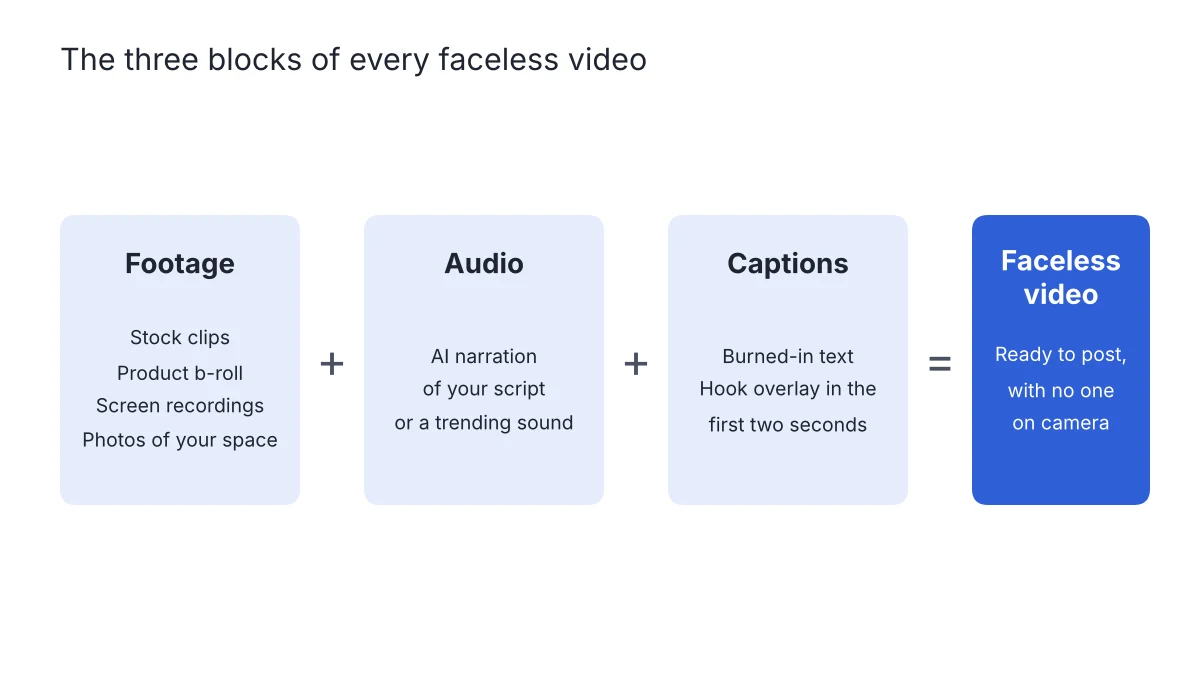
The narration choice matters more than most people expect. AI narration works when you are explaining something: a med spa walking through what happens at a first appointment, or a real estate agent narrating a walkthrough. You write the script, the AI reads it in a consistent voice, and every video sounds like the same brand. A trending sound works when you are showing rather than telling: gym clips, restaurant plating shots, before-and-afters.
Many channels mix both: narration for the first few seconds, then the trending sound takes over. Tools like VideoContent write the script, generate the narration and match it to visuals in one pass, then post the finished vertical video through the TikTok video scheduler.
Captions are non-negotiable. In a 2019 Verizon Media and Publicis Media survey, 69% of people said they watch video with the sound off in public places, so a video without text loses most of them. Burn captions into every clip and add a text overlay for the hook in the first two seconds. Keeping videos under 60 seconds is a good habit: it suits TikTok's pace, and YouTube accepts Shorts of up to three minutes, so the same clip works there too.
How do you write a hook for a faceless TikTok video?
The three-second rule
Viewers decide within the first few seconds whether to keep watching, so your hook has to land before your logo or intro music does. For a faceless video, the text overlay and the first visual carry the whole pitch. Put the hook on screen in the opening frame, not in a voiceover that takes five seconds to get going.
Five hook templates you can fill in
- "Nobody tells you ___ about [your service]."
- "I tested ___ so you don't have to. Here's what happened."
- "If you're paying for ___, stop. Do this instead."
- "Three signs you need ___ in [your city]."
- "POV: you just walked into ___."
Worked examples: a realtor uses number 4 as "Three signs you need a pre-approval in Phoenix" over b-roll of open houses. A gym uses number 1 as "Nobody tells you about progressive overload" over a single clip of a barbell. A med spa can pair number 3 with before-and-after footage; these formats are built into our AI video generator for med spas.
What equipment or tools do you need for faceless TikTok videos?
The minimum kit
You need three things: a phone with a decent camera for b-roll, an inexpensive clip-on mic if you ever record a voiceover, and a free editor with auto-captions. That is the whole list. Lighting rigs, ring lights and teleprompters are optional for formats built on stock footage, screen recordings and text overlays. Captions matter more than gear, for the sound-off reason above.
Where AI video tools fit, honestly compared
The tools split by job. OpusClip and quso.ai cut long footage into short clips. Submagic adds captions and effects to footage you already have. AutoFaceless generates faceless videos from a prompt. VideoContent writes, narrates and renders short videos from your blog posts or business details, then posts them on schedule, with a real estate workflow built in.
Judged on one test, whether an owner with no editor can post every day without touching a timeline, the generator tools pass and the clip-cutters do not. The trade-off: generated videos look templated unless you add your own footage or specifics.
How often should a business post faceless TikTok videos?
A realistic cadence for a business of 1 to 10 people
Three to five vertical videos a week is enough to stay visible without eating your week. Posting steadily beats posting in bursts you can't sustain. Pick formats you can make from material you already have: before-and-after clips, countdown shorts and story videos built from photos you've taken. One filming session can produce several videos.
Batching and scheduled posting
Batching beats daily improvisation. Block 90 minutes once a week, write the hooks and captions, make everything, then schedule the lot. Scheduled posting means videos go out on time whether you're on a job site or serving tables, and a faceless channel can keep running without you opening an editor every day.
How do faceless TikTok ideas differ from faceless YouTube Shorts ideas?
What carries over unchanged
The formats transfer. A before-and-after renovation clip, a text-overlay tip list, a screen-recorded walkthrough and a countdown short all work as vertical video on either platform. Hooks work the same too: the first two seconds still have to name the viewer's problem. If you make the video once with captions burned in, it is reusable.
What to tweak per platform
TikTok discovery leans on hashtags and trending sounds, so keep those current. YouTube Shorts leans more on search and watch history, so put the keyword in the title and pick topics people search for, like "how much does a med spa facial cost". Shorts viewers tolerate slightly slower pacing; TikTok viewers swipe away sooner. Reuse the same video, adjust the title, caption and first frame, and post to both. Our YouTube Shorts ideas without showing your face covers the Shorts side.
FAQ
Do faceless TikToks actually get views for small businesses?
Yes. TikTok says its recommendations weigh how people interact with a video, including whether they watch it to the end, not who is on screen (TikTok newsroom). Before-and-after clips, countdown shorts and text-overlay tips can perform without a face, provided the hook lands in the first two seconds.
Can I use AI narration on TikTok without it sounding robotic?
Usually, if you write the script the way you talk: short sentences, contractions, no corporate filler. AI narration suits explainers such as a walkthrough or a first-appointment breakdown, where a consistent voice makes every video sound like the same brand. For purely visual clips like plating shots or transformations, skip the narration and use a trending sound.
What is the easiest faceless video to make if I have zero editing skills?
A before-and-after clip: film the starting state, film the result, cut between them and add one text hook like "This took three weeks to fix." No transitions, no voice and nothing beyond trimming. The next step up is text-on-screen tips, where stock b-roll and a bold overlay carry the message and a tool burns in the captions for you.
How long should a faceless TikTok video be?
For most faceless formats, 15 to 30 seconds, with the hook in the first two to three seconds. That is long enough to deliver the payoff and short enough that people finish it. Staying under 60 seconds also means the same clip fits YouTube Shorts comfortably; Shorts can run up to three minutes (YouTube Help).
Can I post the same faceless video to TikTok and YouTube Shorts?
Yes, both take vertical video, so the file transfers unchanged. Tweak three things for each platform: hashtags and trending sounds for TikTok, a searchable keyword in the title for Shorts, and the pacing of the first few seconds, since TikTok viewers swipe away faster.