How Much Money Can You Make as an AI Content Creator?
Key takeaways
- Most AI content creators earn little or nothing in their first months; income usually comes from several small streams, not one.
- Platform payouts need thresholds first: YouTube needs 1,000 subscribers plus watch hours or Shorts views, TikTok needs 10,000 followers.
- Short-form views pay modestly, so ad revenue alone rarely covers a living without very large view counts.
- Affiliate links, sponsorships and selling videos to local businesses usually pay sooner than platform programs.
- Do the math with your own numbers: views times what each stream pays, minus tool costs.
You've probably seen the screenshots: "$12,000 last month from my faceless AI channel." Some are real. Most leave out the 11 months of nothing before it, the channels that never took off, or the course they're about to sell you. Here's an honest look at how AI content creators actually get paid, what each stream needs, and how to work out a realistic number for yourself.
Where does the money actually come from?
"AI content creator" covers a few very different businesses. Each pays differently, and at a different stage.
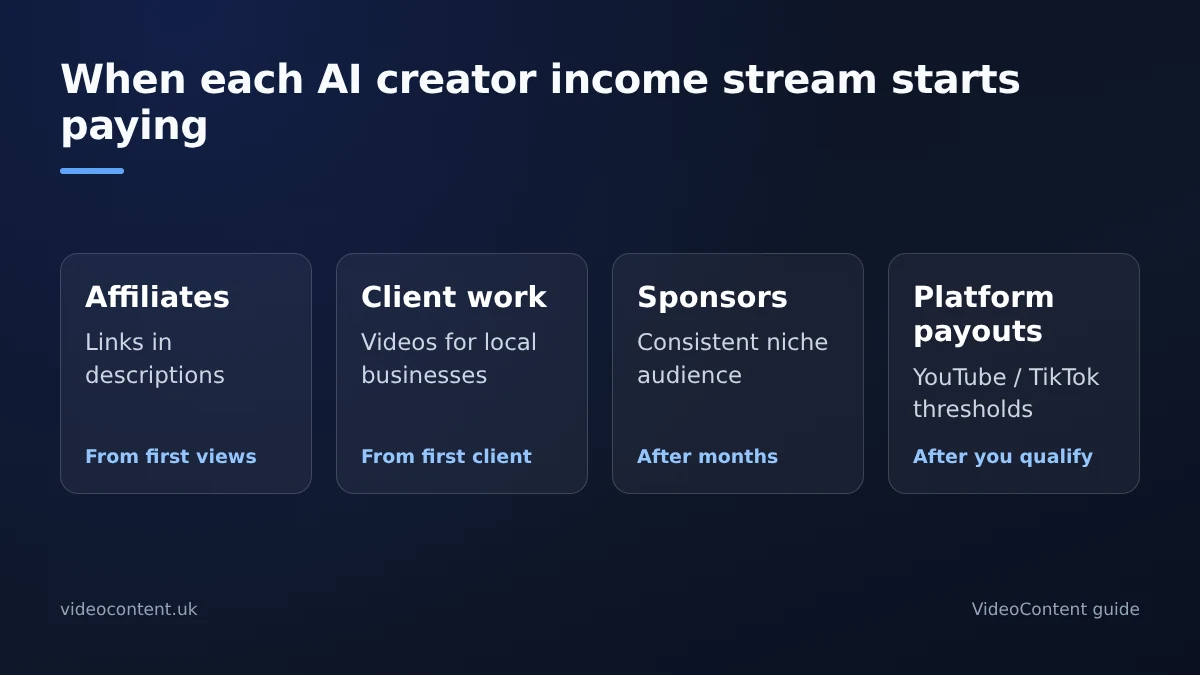
| Income stream | What you need first | When it usually starts paying |
|---|---|---|
| Affiliate links | An audience that trusts your recommendations | From your first viewers |
| Making videos for businesses | One client and a portfolio | As soon as you land a client |
| Sponsorships | A consistent niche audience | After months of steady posting |
| Platform payouts | YouTube or TikTok program thresholds | After you qualify, often many months in |
| Digital products | An audience with a clear problem | Once people ask you for help |
How much do YouTube and TikTok pay?
YouTube Shorts
To share in ad revenue you need to join the YouTube Partner Program: 1,000 subscribers plus either 4,000 public watch hours in 12 months or 10 million public Shorts views in 90 days. Shorts don't earn ads on each video. YouTube pools the ad money from the Shorts feed, covers music costs, then shares 45% with creators based on their share of views. In practice, Shorts revenue per thousand views is low compared with long-form, so a Shorts-only channel needs very large view counts to earn a living.
TikTok
TikTok's Creator Rewards Program requires 10,000 followers and 100,000 views in the last 30 days, and only pays for videos longer than one minute. Payouts depend on views and engagement, and vary a lot by country and niche.
The catch for AI channels
Both platforms review channels before paying. YouTube's monetization policies reject mass-produced, repetitive content, which is exactly what careless AI channels produce. Review every video, and give each one an original angle. Our guide to creating a faceless AI YouTube channel covers the policy line in detail.
How to estimate your own income
Skip the screenshots and use your own numbers. For each stream, write down a monthly estimate:
- Platform payouts: monthly qualifying views, divided by 1,000, times the rate your analytics shows once you're in the program.
- Affiliates: clicks times the share who buy, times the commission per sale.
- Sponsors: number of deals times the fee per deal (small niche channels often start with free products or low fees).
- Client work: number of clients times your monthly fee.
Then subtract your costs: tools, music licences and your time. If one line dominates, that's your real business. For many people starting out, it turns out to be client work rather than views.
What's realistic in the first year?
Honestly: many creators earn nothing in the first few months, and plenty stop before anything happens. The ones who earn usually post consistently in one niche for months, review every video, and add a second income stream early, such as affiliates or a couple of business clients, instead of waiting for platform payouts.
If you want income sooner, the fastest route is usually selling the skill rather than the views: making short videos for local businesses that need them. We cover that in can you make money selling AI-generated content.
Costs to plan for
- A video tool: VideoContent is free to try, Starter $9, Pro $19 (unlimited Standard videos) and Pro+ $39 a month with scheduling.
- Music and stock: use licensed sources or platform libraries.
- Your time: even with AI, reviewing and fixing each video takes minutes, and answering comments takes more.
Keep tool spend small until a stream is paying. Flat monthly pricing is easier to budget than credits that run out after a few renders.
FAQ
Can you make a full-time income as an AI content creator?
Some people do, but it's the exception and usually takes many months. Full-time incomes typically combine several streams, such as platform payouts, affiliates, sponsors and client work, rather than relying on ad revenue alone.
How much does YouTube pay for AI Shorts?
Only channels in the YouTube Partner Program earn from Shorts. YouTube pools Shorts ad revenue and shares 45% with creators by their share of views. Earnings per thousand views are modest and vary by audience and country.
Do AI-generated videos get monetized on TikTok?
They can, if the account meets Creator Rewards requirements (10,000 followers and 100,000 views in 30 days), the videos are over a minute, and the content follows TikTok's rules, including labelling realistic AI content.
What's the fastest way to earn money with AI video?
For many people, it's making videos for local businesses. A single client can pay more each month than a new channel earns from views, and you don't need to wait for platform thresholds.