TikTok Marketing Strategy for Small Business: Daily Posting
Key takeaways
- Map every TikTok video to one of three funnel stages (awareness, consideration or conversion) and judge it by whether it moves viewers to the next stage.
- Pick one metric that matters, such as booked tables or consultation requests, and judge every video against it instead of chasing views.
- Batch a month of videos in one sitting and schedule daily posting rather than filming and editing every night.
- Only add TikTok Shop when you post daily, see buying questions in comments or DMs, and sell a product under roughly $50 that ships easily.
- Run paid Spark Ads only on videos that already perform organically, starting with a few dollars a day for two weeks before judging.
A TikTok marketing strategy for a small business maps every video to a funnel stage: awareness formats like before-and-after clips, consideration formats like answers to common questions, and conversion formats like offers with a call to action. You can build it in one afternoon, post daily on schedule without editing, then add TikTok Shop or paid ads only when the organic numbers justify them.
What is a TikTok marketing strategy for a small business?
A TikTok marketing strategy is a funnel that takes a viewer from the first video they see to their first purchase. It is not a posting habit. You map every short video to a stage (awareness, consideration or conversion) and judge each video by whether it moves someone to the next stage.
The strategy has three layers. Organic content is the base: vertical video posted daily so new local customers keep discovering you. TikTok Shop is the second layer, and it only makes sense once organic videos already draw product questions; eligibility depends on your country and category, so check TikTok's seller requirements first. Paid ads are the third layer, turned on when a video already converts and you want more of the same.
For an example of an awareness-stage video, watch our real estate AI marketing video demo.
How do you build a TikTok marketing strategy in one afternoon?
Step 1: pick the one metric that matters
Decide what a successful first 30 days looks like before you make a single video. A restaurant usually wants booked tables, a med spa wants consultation requests, and a real estate agent wants listing enquiries. Choose one number, write it down, and judge every video against it instead of chasing views.
Step 2: three content pillars, mapped to funnel stages
Awareness videos are the broad ones: a gym walking through a busy floor at 6am, a realtor touring a new listing. Consideration videos answer the questions buyers actually ask: pricing, process, before-and-afters. Conversion videos carry a direct call to action: book, call or claim. One pillar per stage and three video ideas per pillar give you a month of short video mapped out.
Most owners stall here because they picture themselves filming and editing every night. That is the wrong picture. The build-it-once approach is to batch: sit down once, make your 30 videos from your pillars with captions and hashtags, then schedule one a day. A faceless channel works the same way. VideoContent writes, narrates and makes each clip, then posts to YouTube Shorts, TikTok, Instagram and Facebook for you, and if you sell property, the real estate workflow turns listings into a month of shorts in one sitting.
Step 3: batch and schedule, don't post live
Posting on the day tends to fall apart by week two. Batch on day one, schedule the whole month, and set one measurable KPI per funnel stage: watch-through for awareness, profile visits or saves for consideration, and enquiries or bookings for conversion. Review weekly, keep what works and refill the batch monthly.
Which videos belong at each stage of the funnel?
Map every video to a funnel stage before you make it. A promo video does a different job from a countdown short, and measuring both on views hides whether either one sells.
| Funnel stage | Video format | What it looks like | KPI to watch |
|---|---|---|---|
| Awareness | Faceless channel videos, promo videos | Vertical video built from a hook, narration and captions | Views and watch-through |
| Consideration | Story videos, blog-to-video | Explainers that answer "why you?" | Profile visits, follows |
| Conversion | Countdown shorts, offer videos | Limited-time pushes with a clear next step | Clicks and booked appointments |
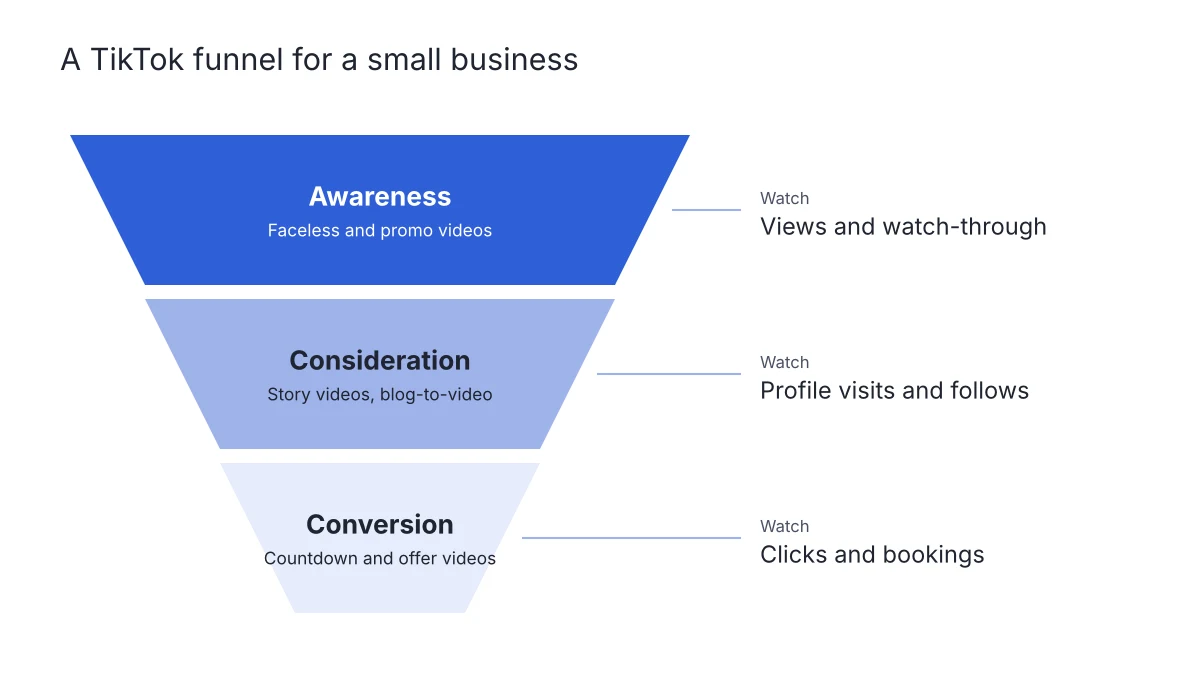
Awareness: faceless and promo videos
Faceless videos and promo clips introduce your business to people who have never heard of you. A gym posts a 30-second tour; a restaurant posts a dish coming off the pass. The only job is getting watched to the end.
Consideration: proof and explainers
Story videos and blog-to-video explainers answer the questions a potential customer actually has: pricing, process, results. Turning an existing blog post into a narrated short with Blog to Video reuses work you already did.
Conversion: countdowns and offers
Countdown shorts push a dated offer: a booking deadline or a seasonal special. When you later pay to promote a converting video, TikTok's Spark Ads boost an existing post, so test organic countdowns first. VideoContent makes videos for all three stages from your business details, then posts them on schedule.
When should you add TikTok Shop?
TikTok Shop earns its place when three boxes are ticked. First, post volume: you are posting at least one vertical video a day, because Shop tags on videos that barely get seen do nothing. Second, an engagement baseline: comments and saves show people already asking "where do I buy this?" or "how much is it?" under your posts. Third, product fit: something under roughly $50, easy to demonstrate on video and shippable without hand-wrapping every order. Miss two of the three, and paid ads or a booking link will convert better for now.
The go criteria
Write the three tests down before you turn Shop on. If your comments are quiet but your DMs are full of price questions, that counts as a yes on engagement. Med spas and similar service businesses should read the criteria honestly: services rarely fit Shop, though retail products like aftercare kits can. The same product-fit thinking applies when picking an AI video generator for med spas to keep daily posting sustainable.
What changes in your content mix once Shop is on
Roughly one in three videos becomes a product demo: an unboxing, a before-and-after or a 15-second "here's how it works" with the Shop tag attached. Awareness content keeps running as usual, but every conversion-stage video now ends with a product instead of a phone number. Treat the first month as calibration: watch which demos sell, then make more of those.
When do paid ads earn their place?
Turn on paid only after organic proves the creative. If a video already pulls views and watch time as a scheduled post, you have evidence the hook works. If nothing has earned attention organically, ads just buy you a more expensive way to find that out.
Spark Ads on proven winners
Spark Ads run paid delivery on an existing post, so its comments, likes and shares stay attached. That social proof matters: a boosted post with real engagement reads as a business people already trust, not as an ad. Pick your two or three best organic performers, promote those, and leave untested videos out.
A starting budget you can justify
Start small enough that a wasted month stings but doesn't hurt: a few dollars a day on one proven winner for two weeks, then judge. The decision is simple maths. If one customer from that spend covers the ad cost plus your time, raise the budget. If not, change the creative before you add money. Keep the organic engine running either way; scheduled daily posts through the TikTok video scheduler are what keep producing the winners you'll promote next.
What can Duolingo's TikTok strategy teach a local business?
Duolingo's TikTok success rests on three things a five-person business can copy: a distinct voice, formats native to the platform, and posting consistently. None of it needs a brand team. The audience is there too: Pew Research Center's social media fact sheet tracks how widely US adults use TikTok, which is why local businesses can reach nearby customers on it, not only teenagers.
Translate it to your scale: pick one recognisable voice for your gym, restaurant or brokerage, reply to comments in that voice, and map each video to a funnel stage instead of chasing trends. The consistency part is mechanical, which is why scheduled daily posting matters more than production polish.
How does a med spa marketing strategy differ on TikTok?
Med spas run on proof and trust, so your videos should lean on process and outcome: treatment walkthroughs, staff introductions and aftercare tips. Describe results carefully. Say "this client reported smoother skin after three sessions" rather than promising a medical outcome, and skip anything that reads as a guarantee. Before-and-after content works when you frame it as one client's story, and captions should name the treatment plainly so viewers know what to ask for at the front desk. VideoContent can make these from a short brief, narrate them and post them on schedule, so you keep a daily cadence without filming every day.
Med spas: proof content without overclaiming
Build a repeatable format: one treatment, one client story, one takeaway. Rotate between story videos, countdowns before a promotion, and answers to the questions your front desk hears every week. Put compliance-minded wording in the script itself, since the AI writes from what you give it.
Gyms, restaurants and real estate: one-line adjustments
- Gyms: film member wins and class energy, not equipment tours.
- Restaurants: kitchen close-ups and daily specials shot vertically.
- Real estate: one property detail per video, then the walkthrough.
Same daily posting habit, different subject.
How do you post daily without ever editing a video?
Daily posting is the whole job, and you can't hand-edit your way to that cadence. Brands that do well on TikTok, Duolingo included, post often and keep their videos native rather than polished.
Running VideoContent through the same criteria
VideoContent handles the funnel end to end: it writes the script, narrates it, makes vertical video with captions and hashtags, then posts on schedule to TikTok, YouTube Shorts, Instagram and Facebook. Blog to Video covers consideration, promo videos cover conversion, and scheduled posting of business videos is on Pro+ at $39 a month (pricing). For a faceless story channel that runs itself, Story Reels is $40 a month. The honest gap: it will not film you doing a gym walkthrough. For footage-first content, you still need a camera.
Where the direct alternatives fit
Submagic, OpusClip and quso.ai start from footage you already have and add captions or cut clips. AutoFaceless and ShortGenius generate faceless shorts. If you already film, start with a clipper. If you will never film, start with a generator.
How do you measure the funnel from first video to first sale?
Check one number per funnel stage, once a week. Awareness: views per video, aiming for your account's median rather than a fantasy number. Consideration: profile visits and follows per 1,000 views. Conversion: link clicks or booking-page visits, whichever matches how customers actually reach you.
Double down when a format beats your median views two weeks running. Change the format when views hold but profile visits stay flat, because the video entertains without selling. Change the offer when visits come but bookings don't.
Log the three numbers in a spreadsheet every Monday. Four weeks of that beats any dashboard you will never open.
FAQ
How long does a TikTok marketing strategy take to show results for a small business?
Expect a first read at 30 days and a real verdict at 90. Daily scheduled posts usually need a few weeks before views settle around your account's median, and signals like profile visits and enquiries follow a few weeks behind that. Judge each video against the one metric you picked, not against a viral fantasy.
Can I run a TikTok marketing strategy without showing my face?
Yes. Faceless formats cover all three funnel stages: narrated vertical videos with captions and hooks for awareness, blog-to-video explainers for consideration, and offer or countdown shorts for conversion. Generators like VideoContent write, narrate, make and post these on schedule. The one gap is footage-first content like a gym walkthrough, which still needs a camera.
Is TikTok Shop worth it for a local service business like a med spa?
Usually not for the core service. Services rarely fit Shop's product model, though retail add-ons like aftercare kits can, if they are under roughly $50, easy to demonstrate and easy to ship. You also need daily posting volume and visible buying questions in comments or DMs first. Otherwise a booking link converts better.
How much should a small business spend on TikTok ads per month?
Start with a few dollars a day on one proven organic winner, run it for two weeks, then judge. That lands around $100 or less for the test month. If one customer from the spend covers the ad cost plus your time, raise the budget; if not, change the creative before adding money. Keep organic posting running regardless.
Do I need a separate TikTok strategy from my Instagram Reels strategy?
Not a separate strategy, just separate distribution. The funnel mapping, three pillars and KPIs stay the same, and the same vertical video can post to TikTok, Reels, YouTube Shorts and Facebook on schedule. What differs by platform is pacing and native style, so check watch-through on TikTok itself rather than assuming Reels results carry over.