TikTok Marketing for Restaurants: A One-Person Playbook
TikTok marketing for restaurants works when every video is tied to one measurable outcome: reservations, catering inquiries, or walk-in promo redemptions. This playbook maps each video format to the result it drives, then shows you how to batch a full month of posts in one afternoon and schedule them around your menu launches, for under $40 a month.
Which TikTok video formats actually drive restaurant reservations vs just views?
Not all formats earn their keep. Some fill your dining room; some just rack up views from people who will never live near you. Here is the honest mapping.
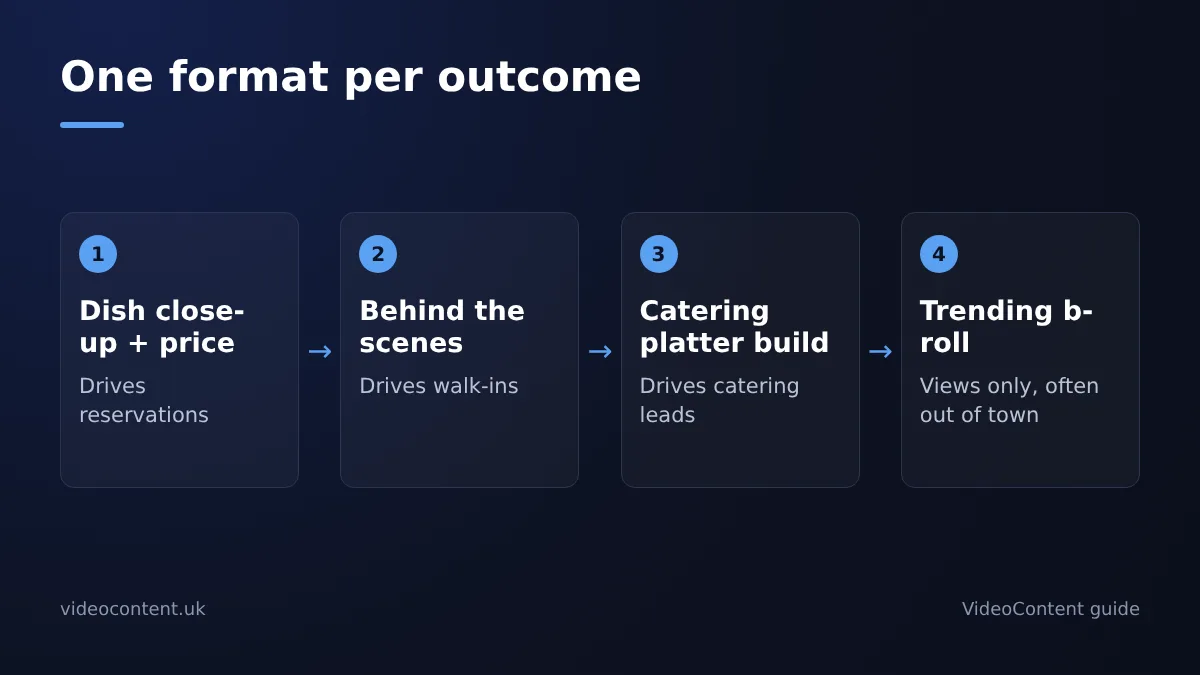
The format-to-outcome table: reservations, catering, walk-ins
| Format | Best outcome | Why it works |
|---|---|---|
| Dish close-up with voiceover + price | Reservations | Viewer knows the dish and the cost before they book |
| Behind-the-scenes prep or staff clip | Walk-ins | Feels local and unpolished, which reads as trustworthy |
| Catering platter build + "we deliver" caption | Catering leads | Speaks directly to office managers and party planners |
| Trending sound + aesthetic food b-roll | Views only | Watchers are often out of your delivery radius |
Why 'aesthetic food b-roll' gets views but not bookings
B-roll travels far because food content is universally watchable, but a viewer two states away liking your pasta clip does nothing for Friday covers. If reach is the goal, fine. If bookings are the goal, name a dish, a price, and a reason to come this week. The same logic applies in any local vertical; a real estate agent filming one listing with a clear call to action converts better than a montage, which is why we built our real estate video generator around that format.
One format per outcome: pick two, ignore the rest
Posting daily matters more than posting variety: consistent posting beats sporadic high-effort drops. So pick the two formats that match the outcome you need this month, batch them, and skip the rest.
How many TikTok videos per week does a restaurant need to post to see results?
Post 4-5 short-form videos per week, minimum, for 60 days before judging results. One "perfect" post a week rarely gets traction because the TikTok algorithm needs volume to learn who to show your content to, and most videos will underperform no matter how good they are.
Why 4-5 per week beats 1 'perfect' post
You cannot predict which video will pop. A shaky 20-second clip of the fryer often outperforms a polished menu montage. Posting 4-5 times a week means 16-20 attempts a month, which gives the algorithm enough data and gives you enough shots at a hook that lands. Batch-producing one afternoon covers the whole week, so daily posting does not mean daily editing. Our AI video generator for restaurants turns a short prompt into a captioned vertical video, so a solo operator can hit that number without hiring anyone. Honest limitation: it will not film your kitchen for you, and phone-shot footage still beats stock clips.
What the first 60 days realistically look like
Weeks 1-4: expect low views, often under 200 per video. That is normal, not failure. Weeks 5-8: one or two videos usually break out as the algorithm finds your local audience. Real outcomes, reservations and catering inquiries, typically trail the breakout by a few weeks, so judge the channel at day 60, not day 10. TikTok describes the signals it uses to pick who sees a video in its explainer (how TikTok recommends videos).
What should a restaurant's first 30 days of TikTok content look like?
Week 1-2: establish the hook formats
Post one video daily for 14 days, all filmed in a single afternoon. Rotate three formats: a 15-second dish close-up with a voiceover hook ("the $14 lunch that sells out by 1pm"), a 30-second kitchen or prep clip, and a staff pick or "order this if" recommendation. Keep captions on every clip and repeat your best-performing hook structure rather than inventing new ones. The goal this fortnight is learning what stops the scroll, not driving bookings yet.
Week 3-4: introduce offers and reservation CTAs
Now cut the three winning formats down to your top two and add an outcome to each: "mention this video for a free dessert" for walk-ins, "DM 'catering'" for private events, and a booking link in your bio for reservations. A business account makes it easier to add a website link to your profile, so set one up before week 3 (TikTok for Business).
For the no-time-to-film days, tools like VideoContent generate scripted vertical videos with voiceover and captions from a prompt, so the daily posting streak survives a busy service week.
How can a restaurant batch-produce a month of TikTok videos in one afternoon?
The 90-minute shoot: 8 dishes, 3 angles, one phone
Set up your phone on a cheap tripod before service and film three angles of each dish you want to promote: a slow pour or slice, a close-up of the finished plate, and a wide shot with hands in frame. Eight dishes at three angles gives you 24 clips, enough raw footage for a month of daily posts. Shoot the sizzling, saucy moments first while the kitchen is hot.
Generating scripts, voiceovers and captions with an AI video tool
The batch math only works if editing takes minutes, not evenings. Drop each clip into an editor or captioning tool like CapCut or Submagic to add the hook, voiceover, and captions in a vertical 9:16 format. You review, tweak the hook if it sounds off-brand, and move to the next clip. For days with no footage at all, a script-to-video tool like VideoContent makes a finished video from a prompt in under 60 seconds, so 20 videos is an afternoon, not a month. Be honest about the trade-off: AI hooks read generic until you edit them, so spend your review time on the first three seconds of each video and let the captions and cuts stand as generated. Faceless formats like dish close-ups with voiceover suit this workflow best.
Scheduling the month so you never open the app to post
Upload all finished videos to a scheduler, tag each one to a menu item or promo date, and set a daily posting time, usually 11am or 5pm for restaurants. Paid tiers on tools like Submagic, OpusClip, quso.ai, and SendShort include scheduled posting, and VideoContent includes it on Pro+ ($39/month). Batch once, then stay out of the app until next month's shoot.
What TikTok content works for restaurants with no on-camera staff?
You don't need a host on camera. The highest-performing restaurant formats are faceless: hands-and-pans cooking shots, plate builds, the fryer basket dropping, the bar pour. Shoot 10-15 of these clips on your phone in one shift, then let text-on-screen and voiceover do the talking.
Hands-and-pans and dish b-roll that needs no face
Hold the camera above the pass or the counter and film the sizzle, the sauce pull, the slice. Keep clips 5-10 seconds, vertical, no talking. A month of Reels and TikToks can come from two busy services.
AI voiceover and captions for menu storytelling
Pair the b-roll with a script: what's in the dish, where the ingredients come from, tonight's special. Auto-captions matter because most viewers watch muted. Post when local diners are scrolling; Sprout Social's research on posting times is a useful starting point. Once videos are made, a scheduler like VideoContent's (on Pro+) posts them so a month of content goes out without you touching the app.
How do you turn TikTok views into walk-ins and catering inquiries?
Geo-hooks: name the neighborhood in the first 3 seconds
"Best tacos in the city" reaches nobody who can actually show up. "Best tacos in [neighborhood]" reaches people ten minutes from your door, and TikTok's algorithm pushes location-named videos to nearby viewers. Put the neighborhood, street, or landmark in the first 3 seconds and in the caption. A viewer who recognizes the crosswalk outside your window is a viewer who can walk in tonight.
Trackable offers: promo codes and 'mention this video'
Give every video one specific next step: "Show this video for a free appetizer with an entrée this week." Then count redemptions. Promo codes like TIKTOK10 work for online orders; "mention this video" works for walk-ins. For catering, skip the code and use DMs instead: pin a comment saying "DM us CATERING for a quote," then reply with your menu PDF and a phone number within a few hours. Track which video drove each inquiry so next month's batch leans into what converted.
How should restaurants schedule TikTok videos around menu launches and seasonal promotions?
The 2-week teaser ramp for a menu launch
Start 14 days out. Post three teaser videos in week one: a close-up of an ingredient arriving, a chef's knife hitting a new cut, a blurred plate under a cloth. Keep hooks vague and captions shorter than 15 words. In week two, post daily: name the dish, show the plating, then film the first customer reaction the day it goes live. Schedule the launch-day video for 11am local time so it lands before lunch decisions. After launch, drop to two posts a week showing the dish selling out or coming back by request.
Seasonal slots: holidays, patio season, local events
Book recurring slots 4-6 weeks ahead: Valentine's, Mother's Day, patio opening, the local festival weekend. Batch these in the same afternoon as your launch content, since the formats are identical. A tool like SendShort can schedule vertical videos in advance so holiday posts publish while you're slammed on the line. If you're generating videos rather than editing footage, check current pricing on the tool's site before committing, since plans change without warning.
Which AI video tools can a restaurant actually use for this?
The criteria: batch generation, captions, scheduling, price
Any tool you pick needs four things: generate a month of vertical videos in one sitting, burn in readable captions, schedule posts without a second app, and cost less than a shift of labor. If it fails the batching test, you will quit by week three.
How VideoContent scores, including its weaknesses
VideoContent generates short-form videos with scripts, voiceover, captions, and hashtags from a prompt. Free covers 3 script generations with no credit card; finished videos start on Pro at $19/month and scheduled posting on Pro+ at $39/month (plans). The honest gaps: it will not film your actual kitchen or your actual staff, so faceless formats only, and you will still spend an afternoon writing prompts that sound like your restaurant rather than any restaurant.
Where CapCut or a captioning tool is the better fit
If you already film clips on your phone, CapCut edits them free. If you only need captions and hooks on existing footage, Submagic, OpusClip, quso.ai, or SendShort do that job. Pick based on whether you need generation or editing.
FAQ
Do I need a business account to run TikTok marketing for my restaurant?
Yes, if you want a booking link in your bio, since a business account is the simplest way to get a website link on your profile. Switching is free and takes minutes in settings. Set it up before week 3 of your content plan so reservation CTAs work from the start.
How much should a small restaurant spend on TikTok marketing per month?
Under $40 covers it. Free tiers get you started, paid plans for AI generation and scheduling tools run roughly $9 to $39 per month, and a basic tripod costs a one-time $15 to $20. The real cost is one afternoon of batch filming per month.
Is it better to post TikToks at lunchtime or dinnertime for a restaurant?
Both work as starting points. Late morning, around 11am, catches people deciding on lunch, and early evening, around 5pm, catches the dinner crowd. Third-party data on food and lifestyle audiences points to those windows. Test each slot for a few weeks and keep whichever drives more redemptions.
Can I make restaurant TikToks without showing my face or my staff's faces?
Absolutely. The strongest formats are faceless: hands-and-pans cooking shots, plate builds, the fryer basket dropping, the bar pour. Shoot 10-15 clips on your phone during one shift, then let AI voiceover, text-on-screen, and auto-captions carry the story. Most viewers watch muted anyway.
Do TikTok videos help with Google search rankings for my restaurant?
Not directly. TikTok videos do not affect Google's local ranking factors. The indirect benefit is real, though: videos that drive walk-ins increase review volume and search demand for your name, both of which help local SEO. Treat TikTok as a bookings channel, not an SEO tactic.