YouTube Shorts Ideas: Fill 30 Days in 20 Minutes
Key takeaways
- Cross 5 hook formats with 6 series types for your niche and you get 30 distinct Shorts ideas in one sitting.
- Number your episodes so viewers know where to start and come back for the next one.
- Keep titles short with one promise each; end captions with a question and use a few relevant hashtags.
- Check an idea in 5 minutes: search demand, three competitors, and whether the hook fits in under 10 words.
- Spend 20 minutes a week picking the next seven ideas, then film or generate them in one batch.
Running out of Shorts ideas usually isn't a creativity problem. It's that you're starting from a blank page every time. Swap the blank page for a simple formula and any niche can produce a month of ideas in one sitting. Here's the system, with examples for local businesses and faceless channels, so you finish with a filled calendar rather than a list of vague inspiration.
How do you come up with Shorts ideas when you run out?
Treat it as multiplication. A few inputs, crossed with each other, give you weeks of concepts. Shorts can run up to three minutes, but most ideas here work best kept short.
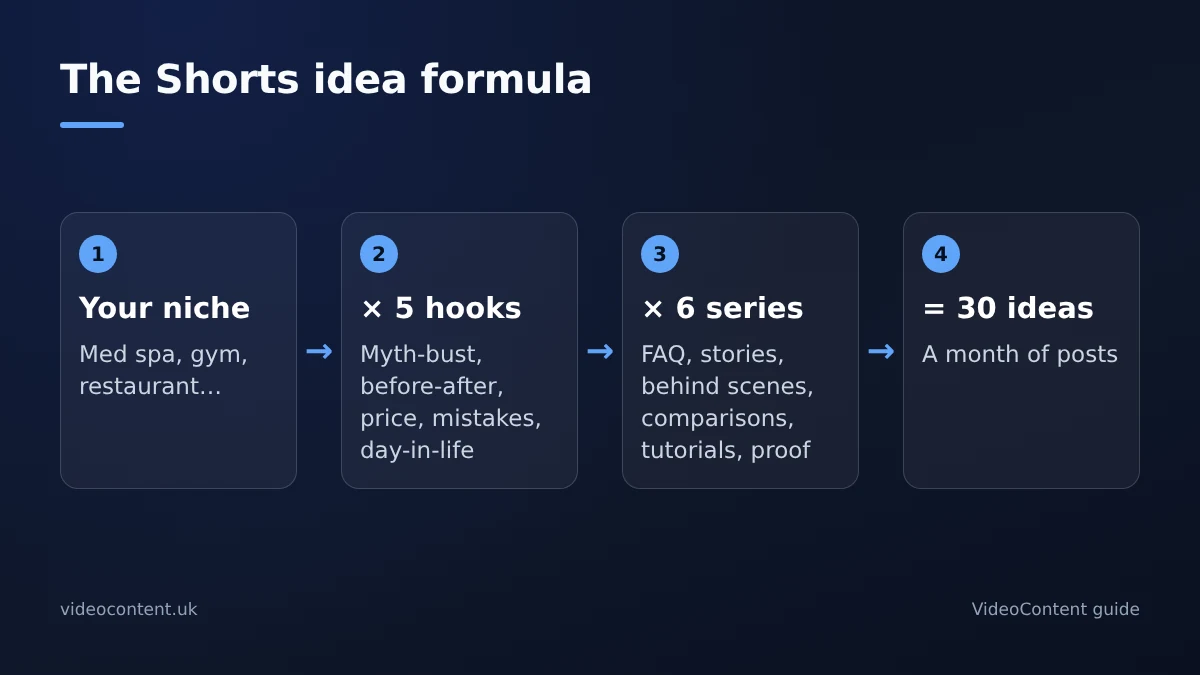
The formula: niche × hook format × series type
Pick your niche, such as a med spa, gym or restaurant. List five hook formats: myth-bust, before-and-after, price reveal, mistake list and day-in-the-life. List six series types: FAQ, client stories, behind the scenes, comparisons, tutorials and local proof. Cross them and you have 30 combinations, each with a built-in hook.
Worked example: a med spa
- Myth-bust × FAQ: "Does Botox hurt? The honest answer."
- Price reveal × client stories: "What these 3 treatments actually cost."
- Mistake list × tutorials: "3 skincare mistakes making your pores worse."
- Before-and-after × local proof: "Six weeks, one treatment plan, real results."
Put each combination on its own row in a spreadsheet and you have a month of calendar slots. For more on mapping ideas to business goals, see our short-form video ideas framework.
Which Shorts ideas work for a brand-new channel?
New channels don't need originality as much as categories they can repeat. These seven cover most local businesses and faceless channels.
| Category | Best fit | Effort |
|---|---|---|
| Before-and-after | Med spas, salons, gyms, home services | Low |
| Myth-busting | Any service business | Low |
| Behind the scenes | Restaurants, gyms | Very low |
| FAQ answers | Any business | Very low |
| Local proof (reviews, walk-throughs) | Home services, estate agents | Low |
| Countdowns and lists | Any business | Low |
| Faceless facts and stories | Faceless channels | Low |
A few notes on each. Before-and-afters sell themselves: show the start, show the result. Myth-busting ("stop pricing your cleaning by the hour") stops the scroll because it contradicts something. Behind-the-scenes clips need no script: the 6am prep, the 5pm rush. Every question a customer asks in person is a Short. For local proof, read out a real review (with permission) over footage of the job. Lists like "3 signs your AC needs replacing" give viewers a reason to stay to the end. And faceless channels can narrate facts or stories over visuals.
Pick one category per weekday and the month starts to fill itself. If you'd rather not film, VideoContent's YouTube Shorts generator turns a short description into a vertical video with captions and a voiceover.
How do you turn one idea into a series?
Named series examples
- Med spa: "Skin Myths #1, #2, #3", one myth per episode.
- Gym: "30-Second Form Fix".
- Restaurant: "What We're Prepping Today #12".
- Salon: "Colour Correction of the Week".
- Estate agent: "This House Sold Because…".
- Home services: "Job of the Day #7".
Faceless channels work the same way; our true crime Shorts generator is built around numbered case episodes for this reason.
Why series beat one-off videos
A series turns one idea into ten videos instead of ten blank pages. Numbering tells viewers where to start and gives anyone who liked episode 3 a reason to look for episode 4. Batch five episodes of one series in a single sitting and a week of posts is done.
Which title formulas get Shorts watched?
- Number + promise: "3 gym mistakes that wreck your first 90 days"
- Question: "Why does your lawn keep dying in July?"
- Before-and-after: "From empty diary to fully booked"
- Myth-buster: "You don't need a big budget for med spa ads"
- Local angle: "The best-kept pizza secret in [your town]"
- Confession: "I was wrong about cold plunges"
Match the formula to the idea: myth-busters for explanations, before-and-afters for transformations, local angles for community content. Keep titles short so they don't get cut off, and put the main keyword near the start.
Title mistakes that cost views
Vague titles ("A day at our salon") give nobody a reason to stop. Clickbait the video doesn't pay off makes people swipe away, which hurts the video. And three ideas in one title means none of them land: one promise per Short.
What should a Shorts caption include?
A good caption has four parts: a line that restates the payoff, the keyword people search for, two or three relevant hashtags, and a question that invites comments. YouTube says its recommendations draw on viewing behaviour, likes, dislikes, subscriptions and feedback from viewer surveys, so videos that keep people watching and responding tend to do better.
Templates you can copy
- Gym: "Nobody tells you this about fat loss. The 10-second test at the end changes how you train. Would you pass?"
- Med spa: "The filler mistake we fix every week. Watch before your next appointment. Would you have spotted it?"
- Restaurant: "Our most-ordered dish, and why. What would you pair it with?"
Hashtags
Use a few that describe the video: one broad, one for your niche and one local, such as #medspa and #austinsalon. YouTube's hashtag rules say tags should relate to the video, and it ignores every hashtag on a video that has more than 60.
How do you check an idea before making it?
The 5-minute check
- Search the topic on YouTube and TikTok. If similar videos have plenty of views, there's demand; if nothing exists, it may be too niche.
- Look at three competitor channels in your area or niche. Have they tried this angle, and how did it do?
- Write the hook as a title and read it cold. If it doesn't make you want to tap, rework it.
When to drop an idea
Drop it if every result is old with few views, if competitor versions all flopped, or if you can't state the hook in under 10 words. Park it in a "maybe" list and look again in a few months.
How many ideas should you batch?
A simple rhythm: collect around 30 ideas a month, make seven a week and post one a day if you can sustain it. Posting consistently matters more than any particular number, so pick a pace you can keep.
The weekly 20-minute routine
Once a week, open your spreadsheet, pick seven rows, give each a title formula and a caption, and you have next week's calendar. Then either batch-film them in one session or generate them. The creative work happened when you built the list; the weekly session is just choosing and scheduling.
Filming vs generating
If you film, shoot all seven in one session at your gym, salon or job site. If you generate, paste each idea into VideoContent; a Standard video is finished within 60 seconds. Pro at $19 a month includes unlimited Standard videos, and scheduled posting is on Pro+ at $39 (pricing). Editors like CapCut and caption tools like Submagic fit later, for footage you've already filmed.
Where an AI generator fits, honestly
Where generating beats filming
Once the calendar is full, production is the bottleneck. For a solo owner posting between shifts, going from "idea checked" to "video ready" in minutes is the main benefit. Generated videos suit tips, lists, explainers and narrated stories.
When you should film instead
A generator can't film your gym floor, your treatment room or a dish leaving the kitchen, and those real clips build local trust better than anything generated. It also won't give you frame-by-frame editing like CapCut, and it doesn't cut up long videos you already have, which is what OpusClip and similar tools do.
Picking a tool for this workflow
- Footage to cut down: a clipping tool like OpusClip.
- Caption polish on existing clips: a caption tool like Submagic.
- Idea to finished video with no footage: a generator like VideoContent.
- Film regularly anyway? Mix real clips with generated ones.
FAQ
How often should a new channel post YouTube Shorts?
As often as you can keep up consistently. Many creators aim for one a day; a few a week you can sustain beats a daily schedule you drop after a fortnight. Batching ideas and production weekly makes a steady pace easier.
How do I come up with enough Shorts ideas for a month?
Multiply instead of brainstorming. List five hook formats and six series types, cross them with your niche and you get 30 distinct ideas, each with a built-in hook and room for numbered episodes.
Do I need to show my face in YouTube Shorts?
No. Narrated facts, stories, tips and lists work without anyone on camera, and a generator can make them from a script. Real clips of your business still build more local trust, so film when you can.
How long should a YouTube Short be?
Shorts can be up to three minutes, but most ideas work best short and tight, with the hook in the first couple of seconds. Make it as long as the idea needs and no longer.