TikTok vs Instagram Reels: Which Should You Post First?
Key takeaways
- Instagram Reels is the better primary platform for most local businesses because existing customers are already there and comments move into DMs and bookings.
- TikTok wins for discovery: it says follower count is not a direct factor in For You recommendations, so a brand-new account can still reach strangers.
- YouTube Shorts should be primary when your videos answer search queries and your sales cycle is long, such as real estate walkthroughs.
- One vertical 9:16 video under 60 seconds can go to all three platforms with only the caption text and hashtags changed.
- If you have under an hour a week for video, focus on a single platform instead of spreading three half-efforts across every app.
For most local businesses comparing TikTok vs Instagram Reels, Instagram Reels is the better primary platform: your existing customers are already there, comments convert to DMs and bookings, and your followers give each video a head start. TikTok wins for reach and discovery; YouTube Shorts wins for search. This guide maps your business type to the right choice.
What is the difference between TikTok and Instagram Reels for business content?
TikTok shows videos to people based on what they watch and engage with, not who they follow. TikTok says neither follower count nor an account's past high-performing videos are direct factors in what it recommends (TikTok newsroom). Instagram shows Reels to your followers in Feed and to people who don't follow you in the Reels tab and Explore, ranked by what each viewer is likely to watch (Instagram Ranking Explained). For a local business, that means TikTok can put your gym or restaurant in front of strangers in your city on day one, while Reels leans on the audience you have already built.
Discovery: interest graph vs social graph
On TikTok, the For You page decides almost everything. A new account with zero followers can reach local viewers if the video holds attention. On Reels, the followers you already have give each video a head start, which rewards consistent daily posting over single lucky clips.
Content style that wins on each
| TikTok | Instagram Reels | |
|---|---|---|
| Discovery | For You page, based on what viewers watch | Followers in Feed, plus the Reels tab and Explore |
| Tone | Raw, talking-to-camera, quick tips | Polished, brand-consistent |
| Best fit | Restaurants, gyms | Med spas, real estate |
Both use vertical video with captions and hashtags. If you run a faceless channel alongside your business account, the same clip can serve both platforms without re-editing.
How do TikTok comments differ from Instagram Reels comments in engagement value?
TikTok comments: unfiltered and conversational
TikTok comments read like a group chat. People ask prices, argue, tag friends, and answer each other before you can. That noise is a feature: a restaurant posting a dish video gets "where is this" and "what are your hours" in the first hour, which is direct local intent you can reply to. The downside is spam and trolls, so you will spend time deleting junk. Reply with a short video answer when a comment is good; that doubles your content for free.
Instagram Reels comments: warmer but thinner
Reels comments skew polite: emojis, "love this," a compliment from someone who already follows you. Fewer questions, fewer price asks. What Reels gives you instead is the DM. Locals who will not comment will message, and a DM is a warmer lead than a public comment. Treat Reels as the platform where conversations move to private.
YouTube Shorts comments: search-adjacent
Shorts comments are fewer but more literal: "do you do walk-ins," "how much is a membership." People often find these videos by searching, so their questions read like search queries. Answer them in the comments and in your next video, and schedule the whole batch ahead with a social media video scheduler so daily posting survives a busy week.
Which gets more reach for a new account, TikTok or Instagram Reels?
TikTok's own explanation of the For You page is why a business page with no followers can still get distribution: a video that holds attention keeps being shown to more people. Instagram ranks Reels by how likely each viewer is to watch, like and share them, and your followers see them in Feed, so reach tends to grow with your audience. Instagram profiles also carry location, contact and booking details, which is why Reels often feels steadier for local audiences. Neither platform publishes reach benchmarks, and one account's results are not a rule.
How to test reach yourself in 30 days
Post the same vertical video to both platforms daily for a month, changing nothing else. Track views per follower and comment quality weekly. If producing a daily clip is the bottleneck, VideoContent's AI video generator for local services writes and renders a captioned video in under 60 seconds, so the test actually happens.
TikTok vs Instagram Reels vs YouTube Shorts: which should a small business post to first?
Decision table by business type
Restaurants and med spas should post to Instagram Reels first, because that is where people already look before booking: they check a profile the way they check a menu, scrolling photos and clips to judge vibe before they ever call. Gyms do well on Reels too, since before-and-after and trainer clips spread through local follows, and a prospective member who sees three transformations in a week already feels like they know the place. Real estate brokerages are the exception: Shorts wins, because listing walkthroughs keep getting surfaced by search months after posting, while a Reel is mostly done in a week. TikTok suits any of these businesses as a second channel once daily posting is a habit, not a starting point, because its reach rewards volume you can only sustain after the workflow is routine.
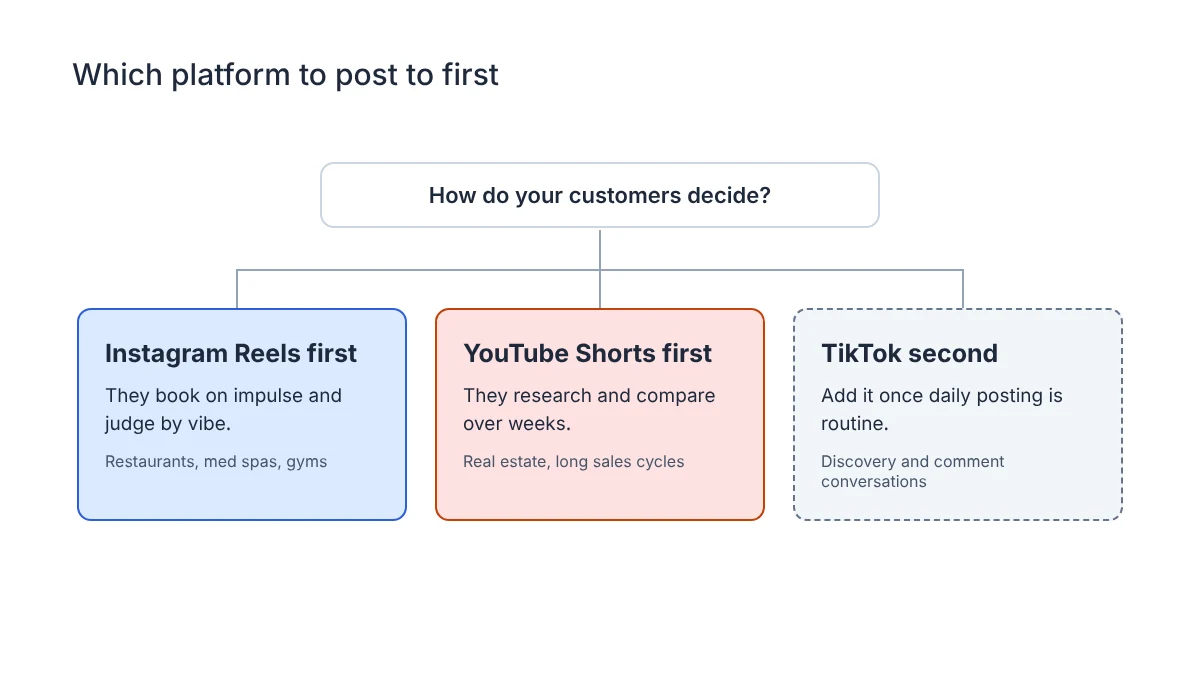
The honest way to pick is to match the platform to how your customer decides. If they book on impulse and judge by vibe, Reels. If they research and compare over weeks, Shorts. If you want comments to turn into conversations you can reply to and book from, TikTok's comment culture rewards that more than the other two.
Whichever you pick, the workflow is identical: one batch of vertical videos a week, captions burned in, and the same campaign details (business, city and offer) reused so production never blocks posting. Schedule the same vertical clip with captions and hashtags from one place like VideoContent, so next week's videos take minutes, not evenings.
When YouTube Shorts should be your primary
Make Shorts primary when your videos answer questions people type into search: "best Pilates studio near me," "how much does a med spa consult cost." Shorts keeps surfacing those clips long after posting, which suits businesses with a long sales cycle. Pair it with clips cut from longer explainer videos, which Video to Shorts does for you, and let scheduled posting keep the channel alive without a marketer on staff.
Which platform's video format and length limits fit which content type?
Length and aspect ratio basics
All three platforms want vertical 9:16 video, so one export fits everywhere. YouTube Shorts accepts videos of up to three minutes. TikTok and Instagram Reels both accept videos longer than a minute, and both have changed their limits more than once, so check the upload screen before planning longer pieces. In practice, clips under 60 seconds work well on all three, and a short, watchable clip matters more than reaching a length limit.
Matching content type to platform specs
Restaurants and med spas: 15-30 second dishes and treatment reveals suit Reels. Gyms: 30-60 second form tips and transformations work on TikTok. Real estate: 1-3 minute walkthroughs fit Shorts best. If you already film long walkthroughs, Video to Shorts cuts them into captioned vertical clips, and VideoContent's restaurant workflow generates caption-ready vertical videos for daily posting.
How should you split one video across TikTok, Reels, and Shorts without re-editing?
The one-shoot, three-platform workflow
Shoot once, vertical, 9:16, and keep it under 30 seconds so it fits every platform's comfortable range. Export a clean master with captions burned in, then upload the identical file to TikTok, Reels, and Shorts. The only per-platform edits are the caption text and hashtag set, which take a minute each. Batch this: film five videos in one session, schedule the week, done.
Where dedicated tools like OpusClip, Submagic, quso.ai, Pictory, and InVideo fit
If your footage is long-form, clip-based tools do the cutting for you. OpusClip and Submagic both turn long videos into short clips with captions, and quso.ai, Pictory, and InVideo cover similar ground from slightly different angles. These are strong picks when your source material is a webinar, podcast, or gym tutorial and you want clips pulled out automatically.
Running the same criteria on VideoContent
VideoContent works from both directions. Business videos and Blog to Video generate short-form video from your campaign details or a blog post, with captions and hashtags, and Video to Shorts cuts long videos you already have into captioned vertical clips. Scheduled posting starts on Pro+ at $39 a month for one platform, and $79 a month posts to all four: YouTube, TikTok, Instagram and Facebook (pricing). The free tier covers testing. The honest trade-off: if you want frame-by-frame control over your own footage, a full video editor fits better.
When is it better to focus on one platform instead of posting everywhere?
If you have under an hour a week for video, single-platform focus usually wins. One platform means you learn one comment culture, one posting rhythm, and one set of formats instead of three half-efforts. A restaurant chasing walk-ins will get more from daily Reels than from three average posts spread across every app.
Signs you should go single-platform
You check comments once a day or less, you cannot answer DMs quickly, and you have not set up a weekly batch yet. If your videos need pinned comments or video replies to convert viewers into bookings, learn those features on one platform first.
When scheduled multi-platform posting is worth it
Once one vertical video is produced with captions and hashtags, scheduled posting to the other two costs you minutes, not a re-edit. That is the point where scheduled posting, such as VideoContent's Pro+ at $39 a month, earns its keep: keep your primary platform manual and conversational, and let scheduling handle the copies.
How do you turn comments on each platform into actual bookings?
TikTok: reply-with-video and DM triage
TikTok lets you reply to a comment with a video, so a question like "how much is a membership?" becomes next day's content. Answer the top three questions this way each week. Move purchase intent to DMs fast, and keep replies short so comment volume keeps climbing.
Reels: DMs and story reshares
Instagram buyers expect to slide into DMs. When someone asks about pricing or availability, reply publicly with one line, then continue in DMs where you can send your booking link. Reshare every Reel to Stories with a question sticker to pull commenters into a conversation.
Shorts: pinned comment to landing page
YouTube Shorts comments convert best when you pin your own comment with a link to your booking page or menu. Viewers read pinned comments, so treat it as your call to action.
FAQ
Is TikTok or Instagram Reels better for getting local customers, not just views?
Instagram Reels usually converts better for local businesses because your customers already follow you there, and comments move into DMs where you can send a booking link. TikTok reaches more strangers faster, but fewer viewers use profiles to check hours or book. Start with Reels unless your sales cycle is long.
Can I post the same video on TikTok, Reels, and YouTube Shorts?
Yes. All three accept the same vertical 9:16 file, so upload one clean master with burned-in captions and no other app's watermark. Only change the caption text and hashtag set per platform. Filming once and scheduling copies takes minutes, while re-editing per platform wastes the hour most owners do not have.
Do hashtags and captions still matter on TikTok vs Reels vs Shorts?
Yes, but differently. Hashtags help all three platforms classify your content, so use a small set of local and niche tags rather than twenty generic ones. Captions matter most as searchable text on Shorts, where people type questions, and as context on TikTok and Reels, where viewers watch muted more often than you expect.
Which platform is easiest for a beginner with no video editing skills?
Instagram Reels, because its in-app editor, text overlays, and trending audio templates handle most of the work, and your existing followers forgive rough first attempts. If even that is too much, generation tools like VideoContent produce captioned, scheduled videos from your business details, so daily posting happens without touching an editing timeline.
How long should a business video be on each platform?
Keep most videos under 60 seconds; short, watchable clips outperform length on all three. Aim for 15-30 seconds for dishes and treatment reveals on Reels and 30-60 seconds for gym tips and transformations on TikTok. The exception is real estate walkthroughs at 1-3 minutes, which fit Shorts' three-minute limit and search behavior.